

As the Supreme Court struck down the legal basis for the Trump administration’s most sweeping tariffs last Friday, the world’s leading players on AI were in New Delhi wrapping up a weeklong summit, the outgrowths of which may prove at least as consequential for the global economy.
The AI Impact Summit in New Delhi is the third major event in as many years to bring together stakeholders at the highest levels to review the progress of this technology and its repercussions. These gatherings, which have grown dramatically in size and scope, increasingly are also opportunities for competitors to size each other up and potentially to match global financing and resources to burgeoning global needs.

Beneath the summitry and spectacle and notwithstanding logistical challenges, the on-the-ground energy in New Delhi was real. The conclave brought together over 100 countries and thousands of stakeholders, including technology firms, government officials, strategists, and members of the financial and industrial sectors that underpin AI’s transformative sweep. This remarkable gathering prominently featured voices from the Global South to inform the debates and issues animating policy in advanced economies, from the financing of mammoth AI projects and related energy infrastructure to regulatory approaches and the competition – both geopolitical and commercial – for talent, hardware, and innovative edge.
During my most recent tenure in government, the question of AI oversight and governance was hotly debated. There were those who believed it was essential to create rules of the road and standards of conduct before AI was deployed in even more consequential ways across a growing range of economic, social, and national security arenas. Others believed these arguments represented a classic case of government overreach, and that any effort to constraint or constrict AI innovation would inevitably backfire. Still others were convinced that the AI race must be won by the United States and other likeminded nations, and that steps to advance the democratic world’s collective capabilities must be undertaken along with initiatives to restrict and slow AI developments in potentially hostile countries. Last week’s forum served to reinforce that as this technology diffuses rapidly, if unevenly, the debates around governance are no longer theoretical but already colliding with complex real-world use cases that span markets and jurisdictions. Nor, as open-source models and niche applications proliferate, are the hottest debates and investments exclusively or even primarily focused on the largest, highest-cost frontier models where the United States maintains a clear lead.
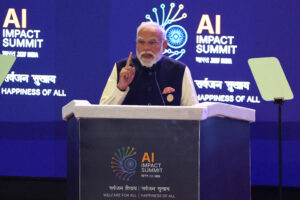
Under the guiding vision and watchful eye of Prime Minister Modi, India as host made clear the nature of its substantial bet on AI as a vehicle for growth, employment, and efficiency in the period to come. The partnerships and commitments that Modi announced, and the prime minister’s emphasis on inclusive, scalable, and affordable AI solutions, reflect India’s efforts to position itself as a bridge to the Global South on AI. Leveraging its demography, talent pool, and experience in digital public infrastructure, India is billing itself as an AI development center and testing ground for applications that can be scaled and exported to other emerging markets. For global business, the opportunities for collaboration are vast, particularly in fields such as agriculture, healthcare, education, and climate adaptation.
Best,
Kurt Campbell
Below you will find a selection of content that most intrigued or educated me this week, including exclusive insights from our new expert-powered and AI-enabled platform, TAG AI.
TAG’s CI Score Detects Regulation-Related Dip, and Structural Policy-Level Jump, for AI Firms
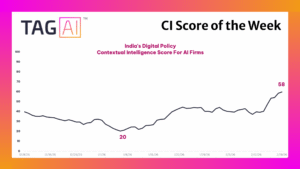
From the perspective of AI firms, the India Digital Policy score started 2026 by dropping down to 20 after regulatory moves by the Indian Ministry of Electronics and Information Technology and the Central Drugs Standard Control Organization, which raised the prospect of increased compliance burdens. But as the India AI Impact Summit 2026 unfolded in New Delhi, the score climbed steadily to 58 on February 19. Senior Indian leaders paired enforcement with symbolic commitments to embracing AI and clear messaging around AI policy: India wants global AI firms to invest and to operate at scale; it will offer a mix of policy and financial incentives to support sovereign AI for public good, and it will have defined rules of the game without regulatory overload.
For AI firms with real-time access to this CI Score, the early dip offered a signal to manage exposure and abide by tighter rules. But the quick rebound represented a marker that this is the time to engage, invest, and partner in the Indian ecosystem. Read more and follow The Asia Group on LinkedIn.
TAG’s CI score tells you what you need to know, supports early warning, signals where to look closer and take action, and prepares your business for the turbulence of geopolitics. Our Contextual Intelligence scores on over 60 business-relevant geopolitical and policy topics are tailored to our clients’ interests and exclusive to TAG AI. Curious? Learn more about TAG AI.
Expert Corner: What Does the Supreme Court Verdict on Trump’s Tariffs Mean for Businesses?

After the Supreme Court decision on Friday that invalidated a wide swath of President Trump’s tariffs, I collaborated with my brilliant colleagues at the Asia Group to share our reaction to the decision. In this piece we share our views on the implications of the decision for the Trump administration’s economic policy, and how countries and companies should react. I always relish the opportunity to learn from my colleagues at TAG, and I hope you will find their views as insightful as I have. Read TAG experts on IEEPA.
To Lam’s U.S. Visit Reinforces Vietnam’s Positive Trajectory
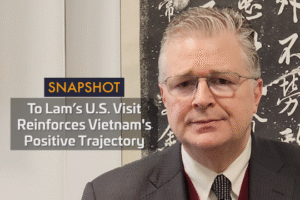
I was honored to meet with General Secretary To Lam of Vietnam during his visit to Washington, D.C. last week. In this video, my colleague Amb. Daniel Kritenbrink discusses that meeting and outlines a bullish outlook for Vietnam and the future of U.S.-Vietnam relations. Dan underscores Vietnam’s ambitious post-party congress development agenda, centered on double-digit growth driven by private sector expansion and foreign investment, particularly in high-tech, energy, transportation, and healthcare. Watch the video here.
The Big Picture: India’s AI Trajectory — From Consensus to Capability

As the India AI Impact Summit unfolded in Delhi, The Asia Group’s team on the ground was at the forefront, serving as a knowledge parter to the summit itself and supporting an array of clients in their engagements. This piece outlines the key achievements and takeaways from the summit with clarity, and specifies key commercial outcomes. A must-read for anyone following the AI revolution. Read the TAG AI exclusive here.
Enjoying Already Tomorrow? Subscribe so that you never miss an issue.