
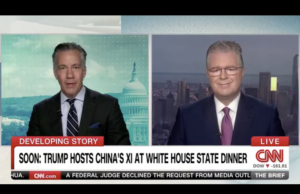
TAG Partner and Co-Chair of Southeast Asia Practice Amb. Daniel Kritenbrink joined CNN’s The Brief with Jim Sciutto on September 24, 2026, to share his analysis on the initial key takeaways from the Trump-Xi summit in Washington, D.C.
Full transcript:
Jim Sciutto, CNN
So, your best assessment as to what all has been accomplished from all this? Lots of pomp, any deliverables?
Amb. Daniel Kritenbrink, TAG Partner and Co-Chair of Southeast Asia Practice
Well, I think the deliverables are a bit meager so far, but I think this visit is largely gone, you know, as expected and as planned. This is a summit defined by optics over outcomes, symbolism over substance.
The main outcome, it’s not just the meeting itself. It’s, you know, it’s optics for a purpose and namely to try to stabilize the us-china relationship and extend this so-called fragile truce between the two powers.
Beyond that, we’ll have to see. I think you could see a few trade, uh, commercial deliverables and the like, but I think the overall focus of the trip has been an extension of this truce.
We should also keep in mind, Jim, the presidents are likely to meet two more times this year. So, if you think about it as a continuum, this is just one stop along the way.
Sciutto, CNN
When secretary Bessent says that the extension of the truce goes until January, that’s not a long time. I mean, do you run up against another brick wall then?
Amb. Kritenbrink
Well, you could, but, you know, think about what he means. He’s talking about the trade truce, right, where the two sides agreed, namely, China would keep rare earths flowing to the United States, to U.S. Companies, and the U.S. would not impose its strictest tech related export controls. I think kicking that can to January is a smart move.
He also hinted that there could be a bigger deal, you know, to be had. So, certainly a truce, even a fragile one, is preferable to a white hot trade war. So I’ll take that. But even Chinese officials are saying they’re already more focused on the meetings likely to take place between the leaders of the G20 and at APEC.
So we’ll have to see. But the two sides have bought themselves some time, and I think that’s good news.
Sciutto, CNN
How about Taiwan? Because that, of course, was a burning question in beijing. The president punted. Does he punt again?
Amb. Kritenbrink
Well, Jim, it feels to me like the Taiwan issue is not central to this visit as it was in Beijing. I mean, our understanding is that really the Taiwan issue dominated the discussions in Beijing. I don’t think that will be the case here in Washington. We’ll have to see what comes out.
But look, I think it’s in both sides interest to maintain the status quo. I think less is more on Taiwan. This is probably a place where you don’t want breakthroughs and you want maintenance of the status quo.
I also think, candidly speaking, that the Chinese may not feel they had to push as hard on Taiwan in this trip, given that, I think they were largely satisfied by the nature of the discussions and the president’s comments publicly afterward in Beijing.
Sciutto, CNN
And how about the arms deal? Then Secretary Rubio said something along the lines of the U.S. Remains committed. But does that mean delivery anytime soon?
Amb. Kritenbrink
Well, we’ll have to see. You know, Jim, under the Taiwan relations act, the U.S. has obligations to help provide for Taiwan’s self-defense. We’ve been doing so since 1979, and I’m confident the United States will continue to meet those obligations. But when – that will be a decision that only the president can make, we’ll have to see.
There’s some talk that you could potentially see movement on that front, perhaps even this year. Others think it may be put off until next year, but I’m confident we haven’t seen the last of U.S. Arms sales to Taiwan.
Sciutto, CNN
President XI Jinping and those around him, they don’t want the Chinese leader to be embarrassed in any way. He’s found himself in the middle of a quite significant domestic issue here. Right. And that is the president denying access to media outlets. And that has meant that there’s been a far fewer images of this and less coverage of the events themselves. Would you expect that on the Chinese side, that is unnerving a bit or upsetting in some way? Disappointing?
Amb. Kritenbrink
Well, Jim, candidly speaking, I doubt it. At least it hasn’t come across that way. I think in the Chinese media, it’s really been wall to wall positive coverage about the tremendous respect that president Xi has been given by president Trump. So I think the Chinese have to be delighted with the way this visit has gone.
You know, historically, in U.S.-China diplomacy, usually it was the Chinese side that was more focused on the pomp and circumstance and protocol face and security and the like. And usually it was the U.S. side trying to drive a hard bargain on substantive outcomes. It’s quite interesting this time that I think for President Trump, he’s probably just as focused on the symbolism as president Xi is.
So there will be, I think, some substantive outcomes. But again, I think they’re going to be limited to probably some Chinese commercial purchases, maybe of agricultural products, maybe of aircraft. I’m hearing maybe a significant Chinese LNG purchase. But beyond that, I think it’s going to be difficult to have anything momentous come out of this visit again, other than extension of this truce.
Sciutto, CNN
And two pandas we learned. But before we go, I’m curious as the president reaches the halfway point of his second term and he’s facing political headwinds at home, is there some point when China calculates he’s a lame duck, right, that there’s not a lot of value conducting long-term negotiations because the timeline is limited under this president.
Amb. Kritenbrink
I think traditionally, Jim, the Chinese friends have known there’s only one U.S. President at a time. And then they know that the president of the United States has awesome power. So, I don’t think that the Chinese are going to start thinking about the president in a supposed lame duck status anytime soon.
I think what I’m more concerned about, Jim, is that I think Chinese confidence is about as high as I’ve ever seen it. They’re confident in their ability to deal with a transactional U.S. president in President trump. They’re delighted that increasingly, China internationally is seen as a responsible power, and the U.S. is seen as the source of instability.
So, despite the fact that they’re a bit uneasy about some of the instability in the international system, I think Chinese friends think most issues are breaking their way. I’m more concerned about that than I am any worry about the Chinese thinking that the president is a lame duck.