

As the next steps for U.S. foreign policy in the Indo-Pacific were debated at the outset of the Biden administration, key players conspired to elevate the format and ambitions of the Quad as a forum for cooperation among the region’s four major maritime democracies: the United States, Japan, Australia, and India.
In private consultations about the possibility of convening the Quad at the leaders’ level, our counterparts in Tokyo and Canberra expressed modest interest but also deep skepticism that India would be prepared to take such a step. Indeed, in initial conversations with Prime Minister Modi’s senior advisors and the Indian foreign office, the message was clear that the time was not quite ripe for the four leaders to meet together. It was only after President Biden and Prime Minister Modi spoke directly that New Delhi agreed to begin a process of higher-level engagements, first virtually during COVID and later in person beginning in the fall of 2021.
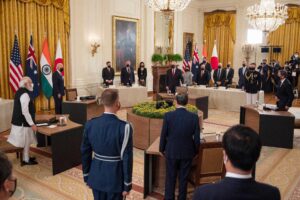
From that initial point of ambivalence, jump four years into the future. The sixth and final Quad summit of the Biden administration was held in Delaware, where the president invited each of the leaders to his home and hosted the day’s formal events at his nearby Catholic high school. There the leaders reflected on the progress made over the previous four years, which indeed was remarkable: huge gains in maritime domain awareness and cooperation, vaccine delivery and health system capacity-building, natural disaster response, and many other areas. We were witnessing the emergence of what was essentially a quasi-alliance among these four major Indo-Pacific powers.
Most significant was India’s trajectory from reluctant initial participant to the acknowledged leader of the Quad. As Trump entered office in 2025, Modi was confident in his ability to manage the administration and firm in the belief that the bilateral relationship would go from strength to strength. For reasons too complex and lengthy to recount here, the last year has seen anything but the progression of the U.S.-India relationship to the next level; instead it descended to perhaps the lowest point since the harshest years of the Cold War.
President Trump’s recent announcement of a bilateral trade deal is therefore most welcome. While details are still to be finalized and the possibility remains for technical disagreements to slow implementation, the deal builds on a year of rigorous trade negotiations and will meaningfully reduce or eliminate tariffs and non-tariff barriers across a range of sectors including autos, energy, and electronics.
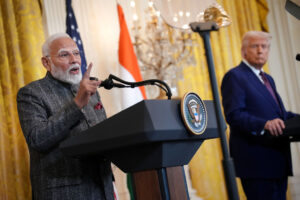
The hope is that this modest set of commitments by both sides will arrest the negative trajectory between Washington and Delhi. It is too early to say, however, whether this critical relationship can regain its former prominence. Indian counterparts put on a brave face, but they are chastened by the experience of the last 12 months and actively seeking to further diversify India’s engagements and economic relationships. The most notable example is the blockbuster trade deal just agreed with the EU, which will link the Indian and European economies in vital ways with respect to technology, innovation, and investment.
It was long thought that one of the most important relationships for the United States in the twenty-first century would be its partnership with India. It may still be possible for U.S.-India ties to reach the heights once foreseen, and this week’s trade agreement is an important and necessary step in that direction. Much more work remains to be done, however, to advance security cooperation, joint technology innovation, mutual economic security, and strategic dialogue if the full potential of that future is again to be glimpsed over the horizon.
Best,
Kurt Campbell
Below you will find a selection of content that most intrigued or educated me this week, including exclusive insights from our new expert-powered and AI-enabled platform, TAG AI.
TAG’s Contextual Intelligence Score Detected Warming US-India Ties Before the Trade Deal Landed
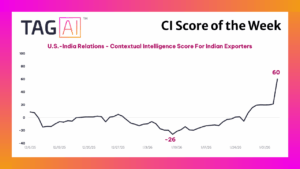
With TAG’s new Contextual Intelligence Score, I’ve been learning new ways to understand geopolitical developments. The CI Score indexes a wide array of open-source information, structured by experts and powered by AI, to detect geopolitical shifts in real time. This week, it tracked the warming relationship between the U.S. and India in advance of the trade deal
For Indian manufacturing export giants, the CI score on the U.S.-India relationship was a gloomy -10 on January 3, even dipping to -26 by January 9 when Trump backed legislation to impose steeper tariffs on India for its purchase of Russian oil. On February 3, the score climbed to +60, a jump triggered by Trump’s announcement of a trade deal with India. Strikingly, over two weeks ago, TAG’s CI score detected the improvement in the bilateral relationship. Read more and follow The Asia Group on LinkedIn.
TAG’s CI score tells you what you need to know, supports early warning, signals where to look closer and take action, and prepares your business for the turbulence of geopolitics. Our Contextual Intelligence scores on over 60 business-relevant geopolitical and policy topics are tailored to our clients’ interests and exclusive to TAG AI.
What Comes Next: The World According to Modi

On Mira Rapp-Hooper’s new podcast, What Comes Next, Ashok Malik discussed the aftermath of the U.S.-India and EU-India trade deals, and how Modi views the unfolding geopolitical tumult. Has India’s embrace of non-alignment proven to be a winning strategy as the world order shifts for good? I found this to be an engaging listen.
The Limits of The India-China Relationship
 Over the past year, I’ve watched as India’s relationship with China has improved. But as my colleague Basant Sanghera points out in this insightful column, there are real limits to that relationship, which continues to be marked by strategic mistrust and geopolitical competition.
Don’t miss an issue of Already Tomorrow. Subscribe now.