
“The message of Xi’s visit is that China remains North Korea’s most important partner, but partnership comes with expectations,” said Han Lin, China Country Director of The Asia Group, during an interview with BBC News on June 8, 2026. “Beijing wants stability, predictability, and fewer surprises. China’s economic and security interests are best served by a calm Korean Peninsula, not by recurring cycles of escalation and crisis.”
Read the full transcript below.
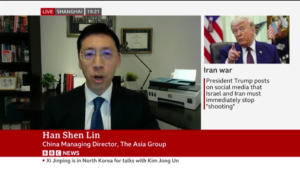
BBC: What should we expect from President Xi’s visit to North Korea?
Han Lin: Investors should view this as a strategic maintenance visit rather than a breakthrough moment. The most likely outcomes are political signaling, closer coordination on regional issues, and potentially modest economic cooperation. The real objective is to demonstrate that Beijing and Pyongyang remain aligned at a time of growing geopolitical uncertainty.
BBC: What is the current state of China-North Korea relations?
Han Lin: The relationship is arguably stronger and more strategically relevant than many assume. China and North Korea remain formal treaty allies under a 1961 mutual defense agreement. That doesn’t mean Beijing supports everything Pyongyang does, but it does mean China remains deeply invested in North Korea’s stability and future trajectory.
BBC: How significant is that alliance today?
Han Lin: The alliance is often overlooked, but it still matters. The treaty remains in force, giving the relationship a legal foundation that distinguishes it from many of China’s other partnerships. The key question isn’t whether the alliance exists—it’s how Beijing would interpret its obligations during a future crisis. Stability remains China’s overriding priority.
BBC: Why is this visit significant right now?
Han Lin: Timing is everything. This visit comes as U.S.-China competition intensifies and security cooperation among the United States, Japan, and South Korea deepens. Beijing is sending a clear message: China remains a central player on the Korean Peninsula and retains channels of influence that few other countries possess.
BBC: What message is Xi Jinping sending to Kim Jong Un?
Han Lin: The message is that China remains North Korea’s most important partner, but partnership comes with expectations. Beijing wants stability, predictability, and fewer surprises. China’s economic and security interests are best served by a calm Korean Peninsula, not by recurring cycles of escalation and crisis.
BBC: Is this visit aimed as much at Washington as it is at Pyongyang?
Han Lin: Absolutely. Every major diplomatic visit has multiple audiences. This visit reminds Washington that China remains an indispensable stakeholder in Northeast Asian security. At a time when U.S.-China relations remain strained, Beijing is highlighting an area where it still holds unique leverage and influence.
BBC: Should markets see this as a risk event or a stabilizing event?
Han Lin: On balance, it’s a stabilizing event. Markets generally prefer engagement to isolation. The fact that Beijing is actively investing diplomatic capital in the relationship suggests China is focused on managing risk and preserving regional stability. That’s not a guarantee against future tensions, but it is directionally reassuring.
BBC: What are China’s core interests in North Korea today?
Han Lin: China’s interests are remarkably consistent: no war, no instability, and no sudden collapse. Beijing wants a stable neighbor on its border and seeks to avoid scenarios that could trigger conflict, refugee flows, or a larger regional security crisis. Everything else tends to flow from those priorities.
BBC: What should businesses and investors watch after the visit?
Han Lin: Watch actions, not statements. The key indicators will be North Korea’s military activity, missile testing, and diplomatic engagement over the next several months. If tensions remain contained, businesses can take that as a sign that Beijing’s efforts to manage risk and preserve stability are gaining traction.
BBC: What’s the bottom-line takeaway for multinational executives?
Han Lin: The bottom line is that geopolitics remains a boardroom issue. This visit is a reminder that security dynamics can shape business conditions just as much as economic policy. Companies operating in Asia should pay close attention to political relationships because they increasingly influence the region’s investment environment.