
Han Lin, China Country Director of The Asia Group observed, “Xi is thinking beyond Washington. The summit is also aimed at Europe, Southeast Asia, and the Global South. China wants countries to see Beijing as indispensable to global supply chains, climate cooperation, and economic growth.”
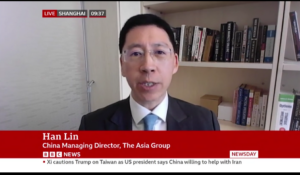
On what Han observed from the Trump-Xi summit:
It’s been very interesting watching the summit to date. And China has approached the summit as a strategic stabilization exercise, not a relationship reset. So it looks like from Beijing’s perspective, the structural competition with the U.S. is now permanent. So Xi Jinping’s goal is to reduce volatility rather than necessarily resolve core disagreements.
On any significant difference from Trump and Xi in approaching the summit and if that difference poses any problem in finding mutual ground:
It does pose interesting challenges. But I do want to mention that Beijing doesn’t treat this leader level summit as just a purely symbolic event. So for example, the stop through Zhongnanhai, where not every senior leader is invited to suggest that Beijing is trying to establish a more personal relationship beyond the institutional relationship between the U.S. and China.
And I think this is true because, when you look at all the differences between both the U.S. and China, China may have concluded that if they don’t manage Trump well, it’ll have to deal with a more hawkish administration, and that’s going to be much more complex.
On the question of trade being the low hanging fruit for Trump during the summit:
Absolutely. If there was any low hanging fruit available, that would certainly be any U.S. sales to China of agriculture, energy, airplanes, perhaps looking at ways to minimize and reduce the fentanyl precursor issues and, of course, improving military to military communications. All would be good. But certainly Xi’s priority seems to be to manage escalation risks and to really buy time.
And this is important from an economic standpoint, because China also needs breathing room. It’s dealing with property sector weakness, cautious customers, slowing foreign investment. So they need to figure out how to manage the commercial side and the economic side as much as the geopolitical side.
On how strong Xi has been in China compared to Trump has been in the U.S. coming into the summit:
China is looking very strong right now. And I think when the summit is occurring right now, China wants to appear as the steadier global actor in contrast to Washington’s election driven political swings, for example. So I think that China is thinking beyond Washington. In other words, the summit is also aimed at Europe, Southeast Asia, the Global South. And China wants the countries to see Beijing as an indispensable global supply chain, climate cooperation, and economic growth partner.