
The United States has long believed that commercial reactor sales were a necessary extension of the historic U.S.-India civil nuclear deal. The chief obstacle for U.S. companies was supplier liability. For the past 15 years, the United States, France, and other international players have urged India to amend or repeal the Civil Liability for Nuclear Damage Act, 2010 (CLND Act) given its liability provisions were inconsistent with the International Atomic Energy Agency (IAEA) standards. The U.S. and India established a contact group on nuclear liability in 2015, and Government of India (GOI) subsequently published “FAQs on Civil Liability,” but these measures were deemed insufficient by American companies, which believed the CLND Act exposed them to unlimited liability.
After years of U.S. engagement, the GOI in February 2025 agreed to “address the issue of civil liability and facilitate the collaboration of Indian and U.S. industry in the production and deployment of nuclear reactors” during Prime Minister Narendra Modi’s visit to Washington. The passing of the SHANTI bill is expected to usher in a new era of commercial partnerships between the Indian private sector and U.S. companies, such Holtec International, Westinghouse, GE, Terra Power, and others.
Key Takeaways
- The SHANTI Bill repeals the Atomic Energy Act, 1962 and the CLND Act, eliminating two critical barriers that deterred international vendors for 15 years: unlimited supplier liability and uncapped operator exposure.
- The legislation permits private companies to build, own, and operate nuclear facilities in partnership with the government, while reserving sensitive fuel-cycle activities for government control. Joint ventures are permitted with up to 49 percent foreign direct investment. Combined with the Nuclear Energy Mission targeting small modular reactors (SMRs) by 2033, this opens opportunities for industrial captive power, including for AI-driven data centres requiring 24/7 baseload power, supporting India’s long-term nuclear capacity goals.
- The legislation permits private sector participation in nuclear power generation, fuel fabrication (up to government-notified enrichment thresholds), component manufacturing, and reactor operations, including SMRs. The Department of Atomic Energy (DAE) will retain control over sensitive functions including uranium and thorium mining, enrichment beyond threshold limits, spent fuel reprocessing and recycling, heavy water production, and high-level radioactive waste management
- The reform represents strategic convergence between sustainable AI infrastructure, compute capacity, and nuclear power, though project bankability will depend on how liability and safety rules are ultimately structured.
Legislative Changes and Business Implications
OVERHAUL OF LIABILITY PROVISIONS
- Supplier Liability: The SHANTI Bill eliminates Section 17(b) of the 2010 CLND Act, which gave operators the right to sue suppliers for incidents resulting from supplier acts including supply of equipment with patent or latent defects or sub-standard services. Under Clause 16 of the 2025 Bill, operators retain recourse only in two situations: where contractual provisions are expressly agreed in writing, or where an individual acts with intention to cause nuclear damage. All automatic supplier liability for defects and services is removed.
- TAG Take: Section 17(b)’s removal aligns India’s liability standards with international nuclear liability conventions, such as the IAEA Convention on Supplementary Compensation (CSC) for Nuclear Damage, which prohibits supplier liability. Previously, suppliers faced unlimited recourse exposure as they could face uncapped claims for latent defects manifesting decades later. The new framework shifts to optional contractual liability, typically limited to equipment replacement or repair and capped at the contract value, while expressly excluding nuclear damage to third parties.
- Channelled Liability: The Bill eliminates Section 46 of the 2010 CLND Act, under which operators could face unlimited additional claims through criminal proceedings, tort law, consumer protection, and environmental violations even after paying the INR 1,500 crore mandated compensation. Under Clause 81 of the new law and the Second Schedule caps, operators now face defined maximum exposure (INR 100 crores to INR 3,000 crores depending on reactor size) that is insurable and bankable, with all nuclear damage claims channelled exclusively through the statutory compensation mechanism.
- TAG Take: The elimination of Section 46 transforms India’s nuclear liability from uncapped exposure to predictable, channelled risk. Previously, CLND Act’s liability caps deterred international vendors and prevented insurance underwriting. The new provisions create the predictability essential for project financing by ensuring that once an operator pays the defined cap, parallel litigations cannot create additional exposure.
- Tiered Liability Caps: The SHANTI Bill 2025 introduces a five-tier liability cap structure based on reactor thermal power, determining the maximum amount each operator must pay based on their reactor size. This replaces the 2010 Act’s flat caps that did not differentiate by reactor size. Maximum overall liability per incident is set at 300 million Special Drawing Rights (approximately USD 430 million), which the government may increase by notification.
- TAG Take: The tiered approach allocates risk by reactor scale while enabling both large reactor projects and SMR deployment. This structure makes insurance calculations predictable while incentivizing safety investment proportional to facility hazard.
Tiered Liability Based on Thermal Power
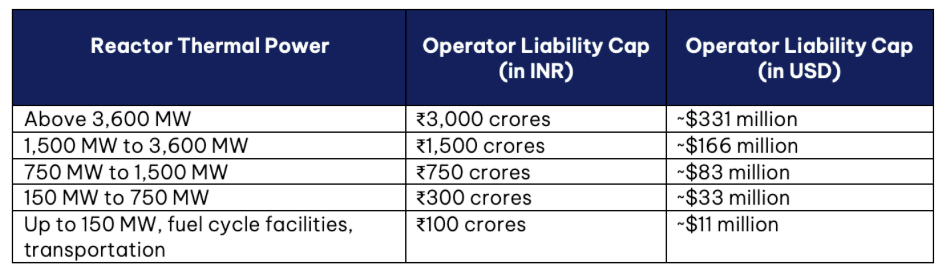
- Layered Compensation Framework: The SHANTI Bill establishes a three-layer compensation framework under Clause 14, when total damages exceed an operator’s liability cap. Operators pay up to their defined cap under the Second Schedule (USD 11.8 million– USD 353 million), after which the government covers excess claims through a Nuclear Liability Fund and may access CSC supplementary funds beyond 300 million SDR. The GOI assumes full liability for government-owned installations and force majeure events including grave natural disasters, armed conflict, and terrorism.
- TAG Take: The multi-tier system ensures adequate victim compensation while capping private sector exposure at defined levels. Unlike Japan’s post-Fukushima experience where the government paid approximately USD 100 billion in unlimited compensation, India’s model provides predictability. Operators know their maximum liability and lenders can model worst-case scenarios as defined amounts rather than unlimited tail risk.
- TAG Take: The rules defining the Nuclear Liability Fund’s financing are yet to be issued. Under the 2010 Act, a similar fund was established in December 2015 and financed through an operator levy of INR 0.05 per unit of electricity generated until reaching USD 23.5 million. The 2025 Bill may follow a similar operator levy approach, though specific financing details have not been specified.
Introduction of Private Sector Participation Framework
- The SHANTI Bill opens nuclear power generation to private participation under Clause 3(1), allowing licenses for government entities, companies, joint ventures, and others approved by the GOI. While the Bill does not specify equity caps, media reports based on cabinet briefings and government sources have suggested a 49 percent limit on private equity in nuclear power projects to ensure the government retains majority control. Clause 3(5) reserves sensitive activities exclusively for Central Government or wholly owned entities: enrichment and isotopic separation, spent fuel management including reprocessing and recycling, heavy water production, and other activities as may be notified.
- TAG Take: The exclusive government reservation for sensitive fuel-cycle activities preserves non-proliferation commitments and control over weapons-grade material. This framework enables multiple participation models: majority private ownership of SMRs for industrial captive power — dedicated units serving energy-intensive facilities; grid-connected large reactors developed as public-private joint ventures; and foreign technology partnerships structured as joint ventures with up to 49 percent FDI.
Nodal Agencies for Oversight and Grievance Redressal
- Atomic Energy Regulatory Board: The SHANTI Bill granted statutory status to the Atomic Energy Regulatory Board under Chapter IV, transforming it from an executive order body (created 1983) into a statutory authority independent from the DAE.
- TAG Take: Statutory independence eliminates the fundamental conflict where the DAE both promoted and regulated nuclear energy. Clause 24 empowers AERB to set radiation limits, frame safety standards, grant authorizations, issue binding directions, and mandate transparency. It is intended to align AERB with global best practices such as seen with the U.S. Nuclear Regulatory Commission (NRC), France’s Autorité de Sûreté Nucléaire (ASN), and the UK’s Office for Nuclear Regulation (ONR).
- Atomic Energy Redressal Advisory Council: The SHANTI Bill established the Atomic Energy Redressal Advisory Council (AERAC) under Clauses 47-48. AERAC will facilitate reconciliation and settlement of disputes, serves as a pre-prosecution filter for criminal complaints under Clause 71, and addresses matters beyond compensation. Appeals proceed through three tiers: Council, then Appellate Tribunal for Electricity (with new Technical Members for Atomic Energy), and finally the Supreme Court.
- TAG Take: The AERAC creates a structured alternative to High Court writ petitions that could take up to 10 years. Its multi-stakeholder composition brings perspectives from the electricity sector, policy, technical, and regulatory domains for holistic dispute review.
This report was prepared by Hamsini Hariharan