

One of the major bipartisan pursuits within the U.S. government over the last two decades has been to redirect military, diplomatic, commercial, and strategic pursuits away from the Middle East and towards the dominant theater of the 21st century: the Indo-Pacific. Indeed, one of the few areas of bipartisan agreement in recent years has been that the United States since 9/11 overinvested in quixotic campaigns in Iraq and Afghanistan rather than focusing on the consequential challenges and opportunities ahead in Asia.
The Obama administration, the first Trump administration, and the Biden administration each undertook efforts to shift critical military and strategic assets to the Indo-Pacific, and to ensure that the defining documents that guide our nation’s approach to the world effectively ensconced Asia as the dominant theater requiring substantial new investments of time and resources. There are too many examples of this pivot to enumerate here; only to say that there was a growing convergence among likeminded officials on both sides of the aisle who observed the structural forces at play in the region – the rise of China, the importance of U.S. strategic allies and partners, the drama of technological innovation, and the military modernization campaigns of virtually every country – and saw an imperative for the United States to play a leading role in shaping the region’s trajectory.
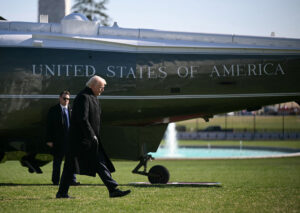
In one fell swoop with his decision to join with Israel to bomb Iran, President Trump – perhaps inadvertently – has sent every element of this trend into reverse: First, the ongoing operations in and around the Gulf are demanding the time and attention of the senior-most leaders in government, which surpass even limited munitions as the scarcest and most important element of American global engagement. Second, military capabilities that had been patiently accumulated in Asia, including an aircraft carrier, anti-ballistic missile systems, and a rapid reaction Marine Expeditionary Unit, have been vacated overnight to the escalating and widening conflict in the Gulf. Third, diplomacy, including a planned summit with China’s leader Xi Jinping and critical engagements with U.S. allies such as Japan, are either postponed or being redirected to address the growing impacts of the conflict.
Some senior administration officials assure us that these moves are merely short-term, and that essential elements of high-level attention and strategic deterrence will return shortly to the western Pacific. However, experience tells us that once drawn into the quagmire of an ill-defined conflict, American strategists have had difficulty extracting themselves from the morass.
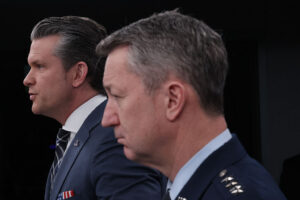
The current conflict in Iran bears sharp resemblance to previous experiences of regional preoccupation and over-commitment. Such an abrupt departure from U.S. strategic purpose in the Indo-Pacific will, no doubt, trouble our closest partners in Asia just as it will encourage Beijing to be ever more confident about China’s own prospects in the region and beyond. While America’s military has performed remarkably on the field of battle, across the Middle East our uniformed men and women continue to be at the mercy of decisions that are poorly informed about the complexities of local circumstances and which underestimate the enormous demands lurking elsewhere, notably in the dominant cauldron of the 21st century, the Indo-Pacific.
Best,
Kurt Campbell
Below you will find a selection of content that most intrigued or educated me this week, including exclusive insights from our new expert-powered and AI-enabled platform, TAG AI.
Stress-Testing the U.S.-Japan Alliance: A Real-Time CI Score Analysis
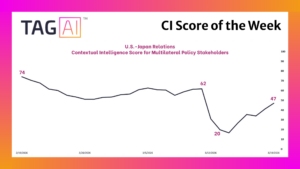
From the perspective of multilateral policy stakeholders, the U.S.-Japan CI score swung from 72 to 20 and back to 47 in under a month — capturing how the strongest alliance in the Indo-Pacific can be stress-tested by converging shocks.
The score peaked in late February as Japan detailed $36 billion in U.S. investments, Japanese Prime Minister Sanae Takaichi secured her supermajority, and the Extended Deterrence Dialogue reaffirmed security convergence between the two countries. It dropped to 55–60 as the Iran war introduced energy supply risks that Japan couldn’t insulate against. Then it collapsed to 20 when the USTR launched Section 301 investigations against Japan, while Donald Trump simultaneously demanded that Japanese warships help in the Strait of Hormuz — a request that ran into both legal questions about the limits of collective self-defense and strong political headwinds in Japan.
The recovery to 47 by the March 19 summit reflects structural depth reasserting itself: a critical minerals framework, $57 billion in energy deals, Golden Dome participation, Tomahawk deliveries, and a potential announcement of a second batch of projects totaling USD 62.9 billion, including next-generation nuclear reactors and gas-fired power generation. Follow The Asia Group on LinkedIn to read the full analysis.
How the Gulf is Positioned to Endure a War in Iran
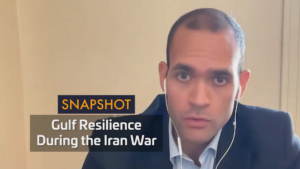
This week TAG announced a new presence in the Gulf, an indicator of the vital importance of the corridor between Gulf states and Asia. As the war in Iran unfolds, I am grateful for the insights of my new colleague Ahmed Helal, managing director for the GCC.
Gulf states can absorb today’s crisis during the Iran war using its massive sovereign wealth funds and reserves to stabilize banks and keep industries running, according to Helal. However, tourism-led diversification will take a major hit. The focus now: diplomacy and de-escalation to protect the region’s economic backbone.
What Comes Next – Trump and Takaichi Meet in Washington
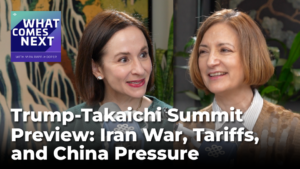
How does Prime Minister Sanae Takaichi get what Japan wants from President Donald Trump when a summit intended to focus on China is suddenly overshadowed by the Iran war?
Mireya Solís, director of Center for Asia Policy Studies and senior fellow at Philip Knight Chair in Japan Studies at Brookings, unpacks Tokyo’s clear priorities for the summit: keeping U.S.-Japan relations on a positive track under an “America First” lens, highlighting major Japanese investment in U.S. manufacturing, reducing reliance on critical minerals tied to China, and strengthening the industrial defense base to bolster deterrence in the Taiwan Strait and the First Island Chain. Then a new test emerges: President Trump’s push for allies, including Japan, to support reopening the Strait of Hormuz amid the Iran war.
What the Conflict in the Middle East Means for China’s Economic Outlook
-
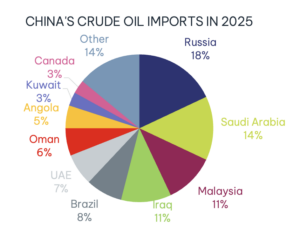
Oil pricing and supply disruptions are China’s top economic risks amid conflict in the Middle East. Half of the country’s oil imports flow through the Strait of Hormuz, and high fuel prices would put pressure on China’s consumption stimulus goals and continued reliance on manufacturing.
-
However, China is relatively well-positioned to mitigate acute shocks, with strong reserves, fiscal controls, and alternate energy sources. China may also be partially shielded from effects by limited continued oil shipments through the Strait and alternate sources. China’s economy also posted strong performance during the winter months, providing extra cushion.
-
The conflict will likely reinforce, not alter, Beijing’s broader economic calculus. China’s new five-year development plan prioritizes energy and industrial self-reliance, and conflict in the Middle East brings further urgency to these efforts.
Enjoying Already Tomorrow? Subscribe so that you never miss an issue.