

When I was a kid, long before the age of streaming and binge-watching, television shows had a reliable trick to keep viewers tuned in: build the audience to a fever pitch of suspense throughout an episode, then flash those three maddening words, to be continued. The recent meeting between Presidents Trump and Xi in Beijing played out with a similar structure, preceded by weeks of speculation as to whether Xi would extract concessions on AI chips or Taiwan, which American executives would go and what kinds of commercial deals might ensue, and even whether the summit would take place at all amid prolonged conflict in the Gulf.
In the moment, the meeting appeared something of an anticlimax, marked by modest announcements on trade, pro forma statements on Iran, and — at least in the initial formal readouts — a notable silence on Taiwan and technology controls. In this sense the summit was also a cliffhanger, leaving the most strategically significant and potentially contentious issues unresolved and at play. Both sides noted plans for President Xi to visit Washington on September 24 — a specific and deliberate teaser for the next episode, meant to signal not resolution but intent. The Chinese very rarely commit that far in advance. Its precision is the message.
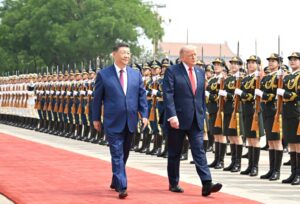
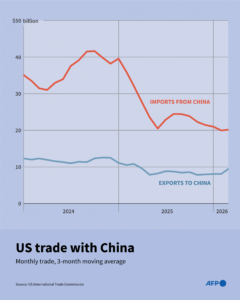
On deliverables, the summit was notably light. There were indications of movement on agricultural trade — beef and soybeans in particular — and on a modest Boeing aircraft purchase deal that could grow over time. But these are down payments, not deals.
What was more revealing was what went unaddressed. There was virtually no public discussion of advanced chips, even as reports emerged that the United States may have agreed to substantial Nvidia exports to key Chinese industrial players. President Trump has an intuitive feel for which issues are politically radioactive within his coalition and within the Republican Party more broadly. He danced around those questions with some care.
The language around Taiwan was perhaps the most consequential silence of the summit. There was strikingly little offered in the way of reassurance to Taipei, but many indicators that Trump is sympathetic to Xi’s perspective and inclined to find ways to accommodate his concerns, if not put longstanding U.S. commitments to Taiwan on the table in future discussions over commercial and investment deals. The extent to which some sort of accommodation takes shape in the months ahead will matter enormously. We will need more time, and more information, before drawing firm conclusions.
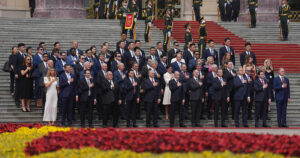
One notable sidebar: it proved very good to be an American CEO traveling with the President of the United States to China. Almost every business leader in the delegation came away with high-level engagements and tangible market deliverables. Such commercial summitry harkens back to a very different era in the relationship, the 1990s, when the objectives of commerce and statecraft were seen as complementary and intertwined. Whether it will remain a feature of U.S.-China diplomacy in this current chapter remains to be seen.
Both leaders spoke conspicuously about sustaining high-level engagement through a defined period and pursuing, in President Xi’s preferred articulation, a “constructive U.S.-China relationship of strategic stability.” Though the Trump team appears to have signed on, these frameworks are rarely neutral instruments. Chinese interlocutors will return to this so-called consensus whenever Washington takes positions Beijing finds inconvenient or challenging. We should be clear-eyed about how that mechanism operates over time.
One last observation, and perhaps the most consequential: there was an unmistakable G2 quality to these proceedings, with imagery suggesting two great powers sitting astride Asia, making decisions that will shape the interests of U.S. allies and partners across the region who had no seat at the table. Interestingly, the G2 concept was once wielded as a cudgel by the U.S. political right against anyone deemed too accommodating toward Beijing. It is ironic, and striking, to see the term now used by some close to the President as almost a goal in itself.
These shifts in framing and political grammar may prove to be this summit’s most durable legacy. In corridors of power across Asia, behind closed doors, there is anxiety. The worst fears were avoided for now, but the next episode is yet to be written
Best,
Kurt Campbell
Below you will find a selection of content that most intrigued or educated me this week, including exclusive insights from our new expert-powered and AI-enabled platform, TAG AI.
A Summit Short on Wins, Long on Signals
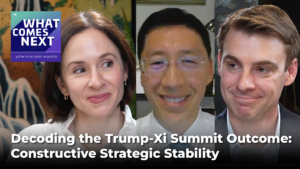
Host and TAG Senior Advisor Mira Rapp-Hooper brings together two conversations to break down the strategic meaning of the Trump-Xi summit. Mira’s conversation with TAG China Managing Director Han Lin unpacks how Beijing framed the meeting around “constructive strategic stability,” why optics may have mattered more than deliverables, and how China is signaling to multinational firms that it remains open for business. Mira and TAG Managing Principal Brett Fetterly examine what this framework could mean in practice, especially for Taiwan, semiconductors, tariffs, critical minerals, and congressional reaction in Washington. Together, the conversations explore why a summit with modest visible outcomes may still mark a significant shift in U.S.-China relations.
What TAG’s CI Score Reveals About the Trump-Xi Summit

In theory, leader-level summits in the U.S.-China relationship create stability by signaling intentions and opening pathways to compromise. In practice, TAG’s “U.S.-China Geopolitics” Contextual Intelligence (CI) score data suggests a different playbook: both sides often amplify leverage ahead of talks — contributing to a pronounced decline in sentiment in the weeks before high-level meetings. TAG’s Associate Vice President Nick Ackert says that drop is typically followed by a short-lived optimism bump as expectations rise, then a return to low levels as core drivers of structural competition return.
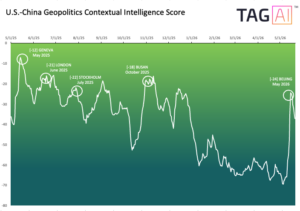
The current trajectory of the score suggests similar pattern, peaking at -24 during the most recent summit, and falling to -37 less than a week later. For business, the takeaway is clear: “stability” may be more elusive than optics and statements suggest.
Washington and Beijing Produce Divergent Readouts on Trump-Xi Summit
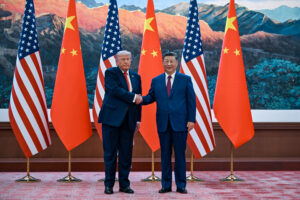
In the days following the May 14-15 Trump-Xi summit in Beijing, both governments released readouts that prioritize formal channels to manage commerce, but diverge on commercial deal details, geopolitics, and next steps for rare earth export controls. Notably, the White House fact sheet adopted Chinese President Xi Jinping’s new phrase “constructive strategic stability” to describe the bilateral relationship. This indicates that the Trump administration is reacting to and incorporating Xi’s framing of the relationship and that this concept may shape future leader-level engagements. Other key takeaways from the readouts include:
Institutionalized mechanisms to manage commerce: Both sides confirmed the launch of a bilateral “Board of Trade” and “Board of Investment,” though neither provided operational details. The Chinese readout explicitly stated that the “Trade Council” would discuss product-specific reciprocal tariff reductions, while the White House avoided direct references to tariffs.
Divergent emphases on commercial deliverables: The White House portrayed the summit as delivering concrete benefits for Americans, highlighting China’s purchase of 200 Boeing aircraft and U.S. agricultural goods. In contrast, Chinese officials described outcomes as preliminary and reciprocal, pairing aircraft…
Did someone forward this email to you?
Sign up now to make sure you never miss an issue.