
Key Takeaways
- Congress remained active on China policy in 2025, advancing a steady cadence of bills and hearings that emphasized strategic competition and risks to U.S. national security. Congress continues to view China policy through a national security lens, with a special focus on technology competition. This bipartisan posture is increasingly at odds with the White House’s engagement-forward approach.
- Although congressional Republicans (and Democrats alike) see political and electoral benefits to making hawkish proposals on China, actual legislative progress has been structurally constrained by the narrow Republican majority in the House, other ambiguous legislative priorities, and President Trump’s policy of commercial dealmaking with Beijing.
- Some of the Senate’s leading Republican voices on China are up for reelection in 2026 and will have to navigate between electoral demands, public polling on China, and President Trump’s diplomatic engagements with Chinese President Xi Jinping that will shape the national conversation on China in 2026.
- Public opinion polling shows that while anti-China sentiment remains high and bipartisan, the intensity of that concern is becoming more issue specific. While national security issues drive broad consensus, the American public is split regarding the U.S.-China economic relationship and Trump’s use of tariffs.
- Overall, U.S. policy toward China will remain a visible – but tertiary – opinion driver in the 2026 midterms, with candidates amplifying issues most sharply when it intersects with local economic concerns, such as agricultural purchases, manufacturing capacity, fentanyl deaths, and consumer goods affordability. Heightened rhetoric is likely from both parties, particularly in competitive districts where candidates might jockey to be seen as tough on Beijing.
- Policy watchpoints in 2026 will center on Trump’s commercial dealmaking with Xi, debates on cross-border investment restrictions, ever-accelerating technology competition, Taiwan, and concerns over China’s coercion of U.S. allies and teamwork with U.S. adversaries.
2025 Congressional Wrap-up
In 2025, Congress maintained a strong focus on China policy. Members continued their advocacy for a range of competitive policies despite the start of U.S. President Donald Trump’s administration, his tariff-first approach to managing competition with China, and Trump’s personal diplomacy and dealmaking with Chinese President Xi Jinping.

Republican national security-oriented lawmakers were optimistic heading into the start of the new Congress and administration that 2025 would be the year that produces a comprehensive China competition bill. These lawmakers were specifically interested in bolstering tools of economic statecraft (i.e., strengthened export controls on advanced technology, restricted outbound and inbound Chinese investment, and orienting the United States towards competition with China on AI and biotechnology.)
In the first half of the year, 19 percent of representatives and 38 percent of senators served as lead sponsors on at least one China-related bill, with partisan distribution heavily weighted toward the GOP. In the House, Republicans introduced 103 bills compared to 22 from Democrats. Senate Republicans introduced 85 bills versus 24 from Democratic counterparts.
The thematic priorities of these bills varied by party and chamber. Senate Republicans were most likely to introduce legislation focused on national security, while Senate Democrats prioritized human rights issues. For House Republicans, human rights and democracy bills were prioritized whereas for House Democrats trade featured as a common bill topic.
Member Time: Hearings and Codels
Time is the most valuable resource for members of Congress. In 2025, Congress devoted even more time to open hearings on China policy. In 2025, Congress held 56 China-related hearings comprised of 36 in the House, 19 in the Senate, and 1 joint hearing. This marks a 47 percent increase in total China hearings from 2024, with the majority held during the first half of the year. In the House, the Select Committee on the CCP, House Foreign Affairs Committee (HFAC), and the Committee on Homeland Security held the most China hearings. In the Senate, the Commerce, Science, and Transportation and the Senate Committee on Foreign Relations (SFRC) held the most China hearings.

U.S.-China technology competition was a particularly common topic, with six hearings dedicated solely to AI and nearly a quarter of all China-related hearings focused on technology or cybersecurity risks.This emphasis reflects the bipartisan consensus that strategic competition is increasingly defined by leadership in emerging technologies and supply chain security.
Additionally, a bipartisan congressional delegation led by House Armed Services Committee (HASC) Ranking Member Adam Smith (D-WA) traveled to China in September, marking the first official bipartisan visit by U.S. lawmakers to China since 2019 — Senators Charles Schumer (D-NY) and Steve Daines (R-MT) made individual trips in 2023 and 2025, respectively. Meetings in Beijing focused on bilateral policy issues including the U.S.-China economic relationship, territorial disputes, non-tariff barriers, and fentanyl. The delegation’s visit signals a cautious reopening of congressional diplomacy after a multi-year freeze. Additionally, it offered Beijing an additional touchpoint on non-executive branch sentiment in the United States and provided members with firsthand engagement at a time when U.S.-China related legislation is growing. In 2026, Senator Steve Daines (R-MT) is expected to lead an additional bipartisan CODEL in advance of the president’s visit to Beijing in April.
The Select COMMITTEE ON THE CCP
The Select Committee on the CCP, led by Chairman John Moolenaar (R-MI) and Ranking Member Raja Krishnamoorthi (D-IL) – wrapping up its third year of oversight activities – continued to leverage its bipartisan bully pulpit to influence private sector decision-making on China and shape the Trump administration’s China policy. However, with the Trump administration pursuing an engagement-oriented strategy with Beijing, the committee’s role has shifted toward spotlighting risks and shaping the political boundaries of action.
In 2025, the Select Committee released 12 public investigatory oversight letters and sent 31 letters to U.S. and China-based companies urging specific policy actions. Unlike in 2024, when automotive, biotech, and manufacturing firms were most frequently targeted, the technology sector led both categories of actions in 2025.

Subtle but important differences have characterized the leadership approaches of Congressmen Moolenaar and Krishnamoorthi. On President Trump’s H200 export control decision, both members signaled concern, but through separate statements that reflect their broader policy and political priorities. Moolenaar emphasized the national security risks of enabling Chinese military AI capabilities. Meanwhile, Krishnamoorthi framed the move as a strategic error by the White House that concedes critical capabilities in technology competition with China.
Substantively, Krishnamoorthi has avoided emphasizing GOP-driven initiatives targeting batteries, electric vehicles, and clean tech supply chains. Inversely, Moolenaar has avoided throwing his support behind Krishnamoorthi’s letters pressing the administration on its broader China policy. These trends illustrate the divergence in the bipartisan consensus on China. As the 2026 election cycle intensifies, Republican positioning on China will be increasingly defined by President Trump’s approach, while Democrats may have more flexibility to maneuver heading into the midterms — even as their ability to advance legislation remains limited.
LEGISLATIVE OUTCOMES
Despite the strong interest in legislating on China and Republican control of the White House and Congress, President Trump’s legislative agenda was overwhelming focused on non-China issues. Congress spent most of its political energy in 2025 confirming nominees, passing a budget reconciliation bill, raising the debt ceiling, and funding (and then reopening) government. However, a few major pieces of China legislation made it to the President’s desk.
De Minimis: The One Big Beautiful Bill Act (OBBBA), Congress’ July 2025 reconciliation bill, set a sunset date of July 1, 2027, for the de minimis loophole which exempted overseas goods under USD 800 from import duties. The delayed sunset will ensure that de minimis is phased out, regardless of the Supreme Court’s ruling on the legality of the Trump administration invoking the International Emergency Economic Powers Act (IEEPA) to institute broad tariffs and immediately sunset the loophole. The provision grew out of the End China De Minimis Abuse Act, which was passed by the House Ways and Means Committee but encountered hurdles in the Senate Finance Committee.
Outbound Investment: After four years of debate and tumultuous conference proceedings in 2025, outbound investment restrictions ultimately made their way into the 2026 National Defense Authorization Act (NDAA), reflecting Congress’ bipartisan support for tightening controls on U.S. capital flows into sectors that may support China’s military industrial complex. National-security minded lawmakers and China Hawks in both chambers have argued that American investment into China should not fuel sectors associated with Chinese military modernization or surveillance. The inclusion of the Comprehensive Outbound Investment National Security Act of 2025 in the NDAA also signals Congress’ continued willingness to legislate in this space even as China hawks’ views on U.S.-China strategic competition diverge from the White House.
BIOSECURE Act: The BIOSECURE Act, which is also included in the 2026 NDAA, bars federal agencies and federal fund recipients from “procuring biotechnology equipment or services provided by companies of concern” listed on the Department of War’s (DOW) Section 1260H list of Chinese military entities or an Office of Management and Budget (OMB) designated list. The act was originally introduced in the 118thCongress by Senator Bill Hagerty and later passed the House on a bipartisan basis but was stonewalled by Senator Rand Paul (R-KY) in the Senate. While the version that was included in this year’s defense bill is relatively weaker than its original, codifying a new federal funding ban on biotech represents a major milestone for legislating on Chinese biotech concerns.
Given congressional interest in legislating on AI export controls, the GAIN AI Act was a major point of contention throughout this year’s legislative debate on China. The bill proposes new limitations on U.S. chipmakers exporting leading-edge semiconductors including a right of first refusal that would require firms to fulfill domestic orders before selling chips into countries of concern. The bill, included in the Senate passed version of the defense bill, would also codify current export control restrictions. It generated opposition from the White House AI czar David Sacks, as well as leading semiconductor design firms such as Nvidia, which sharply increased its Washington lobbying presence this year. After opposition from the White House and House leadership, the bill was dropped from the defense bill during conference negotiations.
- The Trump administration’s commercial-oriented chips policy has marked a significant departure from the bipartisan consensus around advanced semiconductor export controls. In parallel, members in both chambers have introduced a suite of bills (identified in the Appendix) focused on codifying the existing export control regime, blocking advanced chip sales to China, and tightening enforcement of existing controls. Their progress will be an important 2026 watchpoint, particularly because their success may hinge on whether hawks in the administration choose to champion them.
U.S. Public Opinion Polling of China

As members begin to enter the 2026 election cycle and begin to triangulate around President Trump’s approach to managing China policy, they will be guided by public opinion polling on China as they consider campaign messaging and driving China policy initiatives on Capitol Hill.
General Favorable/Unfavorable: In 2025, 77 percent of Americans continue to have an unfavorable view of China. Between 2024 and 2025, the percent of Americans who have a very unfavorable opinion of China has declined from 43 to 33 percent.
National Security: 80 percent of Americans continue to perceive China as a threat to U.S. national security. However, the share of Americans who believe that China is the greatest threat to the United States has declined from 50 to 42 percent from 2023 to 2025.
Data Security: A majority of Americans remain broadly concerned about China-based espionage and surveillance operations on U.S. soil, with 84 percent concerned about telecommunications companies collecting data and 82 percent of Americans concerned about TikTok surveillance.
Trade: 46 percent of Americans believe that China benefits from bilateral trade more than the United States. 60 percent of Republicans concur with this view while Democrats are more divided.
Tariffs: An April poll indicated that 52 percent of Americans believed that tariffs on China would have a negative impact on the United States. These numbers are sharply split by party affiliation with 80 percent of Democrats believing that tariffs would be harmful while only 24 percent of Republicans agree.
Taiwan: Americans in both parties remain broadly supportive of U.S. military action to defend Taiwan with 75 percent of Democrats and 70 percent of Republicans in concurrence. Americans are most concerned with Taiwan’s centrality to semiconductor supply chains and the implications that a conflict over Taiwan would have for U.S. allies in the region.
Republican Base Polling: Polling of Trump voters shows that the president’s base favors a tougher China policy.
- Chinese Investment: 68 percent strongly support blocking Chinese land acquisitions in the United States while 54 percent strongly support ending state/federal worker retirement fund investments in Chinese firms.
- Tawain: 73 percent believe that preventing a Chinese invasion of Taiwan is vital to U.S. national security.
- TikTok: 92 percent remain concerned about TikTok following the announcement of a deal, with 66 percent wanting to see the terms of the arrangement.
- Decoupling: Polling indicates that 70 percent of Trump voters polled are not satisfied with the administration’s efforts to “secure strategic independence.”
2025 polls suggest that while anti-China sentiment remains high, the intensity of public concern is becoming more differentiated across issue areas. Overwhelming bipartisan support for defending Taiwan and continued concerns about espionage speak to the durability of national security anxieties, especially when tied to tangible risks such as semiconductor supply chain disruptions. While Americans show broad bipartisan agreement on many China-related issues, the sharpest divergence with the administration emerges around the use of economic levers such as tariffs and export controls to reshape the U.S.-China trade relationship.
2026 Congressional and Midterm Election Outlook
Congressional Republicans enter 2026 facing mounting structural constraints that will politically complicate all legislative activity, not just China-related legislation. House Speaker Mike Johnson’s management of the chamber is increasingly under pressure following the 43-day government shutdown and one of the least active starts to a congressional session in modern memory. There is no clear legislative agenda for 2026 beyond managing the midterms and averting another government shutdown on January 30, the expiration of the continuing budget resolution for roughly nine government agencies.
The House Republican majority continues to narrow. Johnson can afford to lose no more than three votes on most party-line measures — which increases the leverage of small political factions across the conference. 23 House Republicans have announced their retirements – exceeding the number of exits in the 118th Congress – and there is reporting that as many as 20 additional Republican members may announce retirements in the coming weeks. In short, the number of competitive House races in 2026 may grow exponentially.
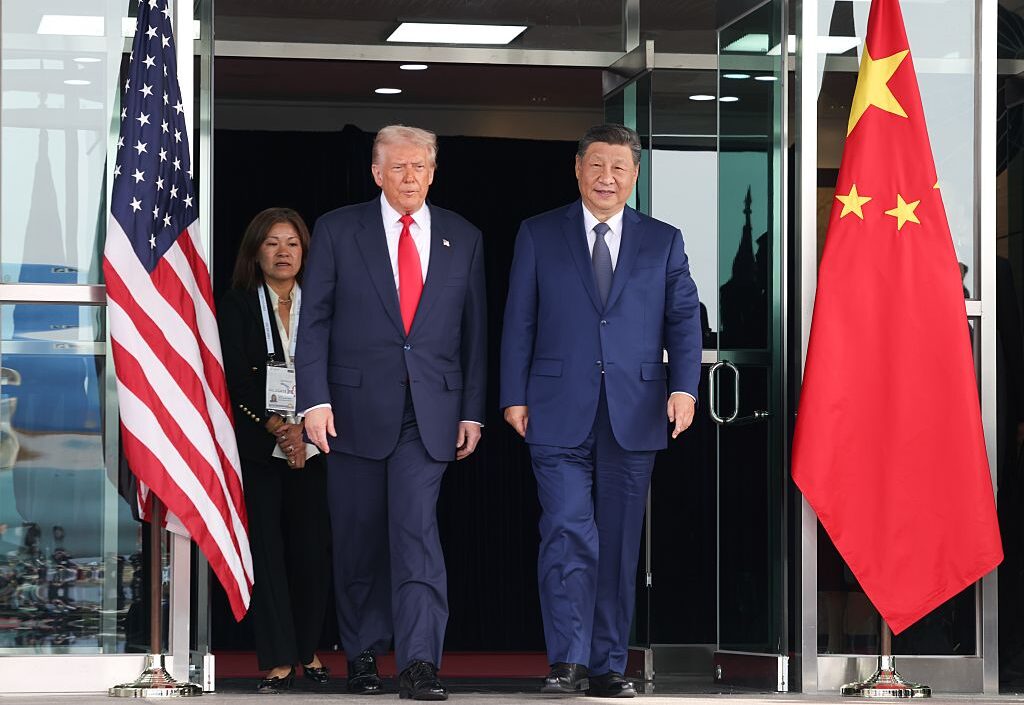
U.S.-China issues will feature unevenly across the 2026 midterm map, driven in part by President Trump’s planned April 2026 trip to Beijing and President Xi’s subsequent state visit. These diplomatic touchpoints will create moments of heightened public attention on trade, security, and technology issues that campaigns across both parties may use to win over voters. While most races are unlikely to calibrate their central message around China policy issues, the national environment shaped by leader-level diplomacy, commercial negotiations, and domestic political reactions could impact voters on the margins.
Agricultural purchases remain one of the most politically sensitive components of U.S.-China economic relations, especially in Midwestern states that have faced volatility during earlier trade battles. China’s recent resumption of soybean purchases has eased some farmer concerns, but uncertainty around future purchases continues to shape perceptions. Manufacturing concerns may also play into the narrative in competitive Midwestern races in Iowa, Michigan, and Ohio, where candidates from both parties are expected to advocate for domestic industry protections.
2026 Senate Elections
In the Senate, Republican China policy leaders are up for reelection.While most of these members are in relatively safe seats, President Trump’s diplomacy and dealmaking with Xi Jinping will keep China at the forefront of the news cycle. This will force campaigns to react to a policy approach that is generally at odds with their legislative record. Senate Republican China policy leaders seeking reelection include:
- Senators Tom Cotton (R-AR), Pete Ricketts (R-NE), and Mike Rounds (R-SD) have all advanced chip-related export control legislation, arguing that U.S. technological leadership requires more aggressive controls on advanced technology to compete with China. All were highly critical of the Trump administration’s decision to allow the sale of advanced chips to China and worked to prevent that decision on the front-end. Cotton, Chairman of the Senate Intelligence Committee, specifically has been a leading voice for strategic decoupling in the Senate, establishing himself as the Senate partner of choice for China Select Committee oversight efforts.
- Senate Foreign Relations Committee Chairman Jim Risch (R-ID)has introduced seven China-focused bills. This is more than any other Senator and focus on a range of topics including curbing the flow of fentanyl precursors, coercive actions toward Taiwan, and AI diplomacy. He is the primary champion for Congress to restart a comprehensive China competition legislative package.
- Senators Bill Hagerty (R-TN) and John Cornyn (R-TX) just secured major legislative victories in the annual defense bill by being leading advocates for the BIOSECURE and Outbound Investment bills across multiple congressional sessions. Cornyn is in a very competitive primary election.
- Senator Lindsey Graham (R-SC) is one of President Trump’s closest congressional advisors on foreign policy issues. He has a longstanding record of being a national security hawk and has spent most of 2025 working to increase sanctions on Russia, specifically targeting Chinese purchases of Russian oil.
- Senator Dan Sullivan (R-AK) has used his role as the current chair of the Congressional-Executive Commission on China (CECC) to focus on political repression and censorship issues.
- Sen. Steve Daines (R-MT) has worked to position himself as the chief Senate Republican diplomat to China. Earlier this year, Daines attended the China Development Forum (CDF) and met with China’s premier Li Qiang. Daines is also likely to lead a CODEL to China prior to President Trump’s April visit and has generally leaned into the President’s pro-commercial engagement approach to China.
Four Senate races are currently identified as tossups: Maine, Michigan, Iowa, and Ohio. Each have unique China policy dynamics animating electoral politics.
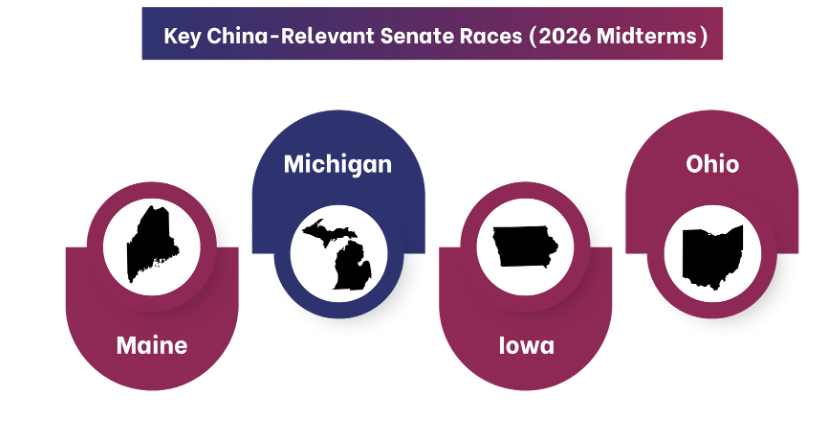
Maine: Maine represents one of the only realistic pickup opportunities for Democrats in 2026. While Senator Susan Collins’s (R-ME) – Chair of the Appropriations Committee and a prominent member on the Senate Intelligence Committee – approval rating has dipped in recent years, she was able to successfully fend off a well-funded Democratic challenger in 2020. Her likely Democrat opponents, Governor Janet Mills and Graham Planter, are currently locked in a competitive primary. If Collins is unseated, Senator Murkowski (R-AK) would likely assume the Appropriations gavel and ensure broad continuity in the committee’s approach to China.
Michigan: Senator Stabenow’s (D-MI) retirement has transformed Michigan into one of the most competitive Senate races of 2026. The Democratic primary is currently led by Congresswoman Haley Stevens (D-MI-11). On the Republican side, former Congressman Mike Rogers is favored to win his primary. Congresswoman Haley Stevens currently serves on the China Select Committee and recently introduced the Unearth America’s Future Act which aims at reducing domestic dependence on China for critical minerals. Meanwhile, Mike Rogers criticized a now-cancelled plan by Chinese battery manufacturer Gotion to construct a facility in Michigan. While U.S.-China issues will likely not be a dominant theme in the Michigan race, they may shape the contest at the margin given the state’s manufacturing base. Concerns about overcapacity and foreign investment may influence voter perceptions and provide messaging fodder for candidates in both parties.
Iowa: Although Senator Joni Ernst (R-IA) is retiring, Iowa’s 2026 Senate race continues to favor the GOP. On the Republican side, Congresswoman Ashley Hinson (R-IA-02), who serves on the China Select Committee, is the clear frontrunner and has made U.S.-China competition a relatively prominent campaign theme. Democrats are locked into a competitive three-way primary. China policy is expected to play a more visible role in Iowa’s 2026 Senate race than other states, largely because of the lingering effects of U.S.-China trade tensions over soybeans. As the country’s second-largest soybean producer, Iowa farmers were hit hard by China’s suspension of soybean purchases in retaliation for the Trump administration’s tariffs. Although purchases have resumed after Trump and Xi’s meeting in South Korea, Iowa farmers may still have long-term concerns regarding the stability of trade with China.
Ohio: The 2026 special election to fill Vice President J.D. Vance’s Senate seat features Senator John Husted (R-OH) who currently holds the seat and former Senator Sherrod Brown, the likely Democratic nominee who lost his seat in 2024. Brown previously chaired the Senate Banking Committee and built much of his national profile around economic populism and manufacturing issues related to China. China policy featured heavily in Ohio’s 2022 and 2024 elections, and in 2026 both parties are poised to continue to emphasize China’s economic impact on Ohio’s manufacturing base. The political landscape is further shaped by state-level interest in restricting Chinese ownership of property in Ohio.
2026 House Elections
Although President Trump’s year of engagement will keep U.S.-China relations in the headlines, the role of U.S.-China issues in House races is likely highly uneven. Across the map, cost-of-living concerns are expected to define both parties’ strategies in 2026. Democrats enter the cycle facing structural headwinds including several Biden-to-Trump districts where Democratic incumbents narrowly won even as Trump carried the top of the ticket. However, the party’s better-than-expected performance in 2025 contests has modestly improved its outlook heading into the cycle.
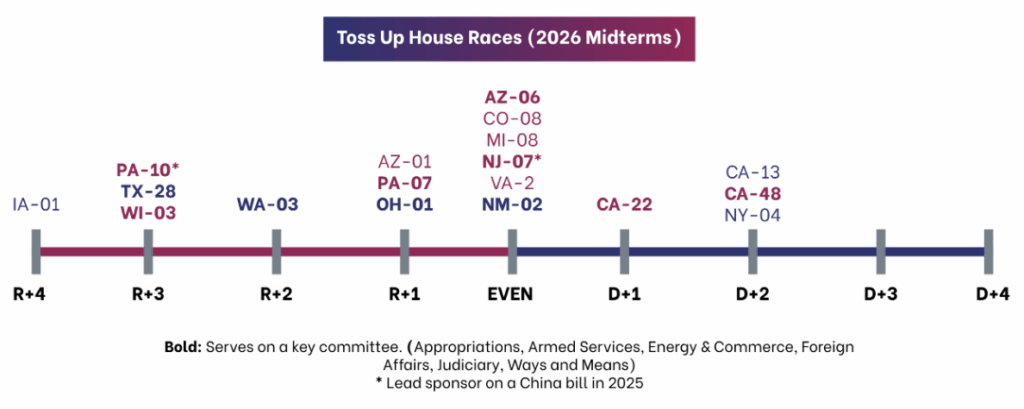
None of the members of the Select Committee are defending toss-up seats, and some of its most visible figures such as Ashley Hinson (R-IA-02) and Raja Krishnamoorthi (D-IL-08) are running for Senate. Across all toss-up districts only Congressman Thomas Kean Jr. (R-NJ-07) and Scott Perry (R-PA-10) were lead sponsors on 2025 China legislation. While U.S.-China issues will likely remain prominent in the national conversation, most swing-district campaigns are unlikely to treat them as central messaging points unless there are natural openings for candidates to tie Beijing to parochial issues or economic volatility.
For Republican incumbents in competitive districts, navigating China issues is further complicated by the electorate’s general perceptions of China and their proximity to President Trump. Aligning closely with Trump can be helpful in signaling support for the administration’s diplomatic engagements and avoiding White House scrutiny during primaries. The same proximity carries risks in a general-election environment where the president’s approval ratings have dropped and voters view China policy issues through the lens of kitchen-table issues rather than geopolitical maneuvering.
Policy Watchpoints
Trump’s April Visit to Beijing: Trump’s planned April visit to Beijing is poised to become an early test of how political, commercial, and personnel dynamics will shape U.S. domestic politics on China in 2026. How hawkish Republican lawmakers message about the trip and conduct oversight of government agencies, companies, and organizations engaged in U.S.-China commercial diplomacy and dealmaking will be an early window into campaign politics and possible legislative activity on China. Use Congress’ bully pulpit to either discourage CEOs from joining Trump’s delegation or discourage dealmaking on issues like Chinese investment in the United risk drawing fire from the president. While Republicans have generally deferred to the White House on China-related messaging, there may be limited opportunities to advance legislation such as the Chip Security Act in the name of leverage building supported by polling of the Republican base that endorses a hardline approach to China.
Debates Around Investment: The tension over both Chinese investment in the United States and American investment in China is likely to remain a domestic watchpoint. Polling of the Republican base remains largely opposed to Chinese investment and the inclusion of the Comprehensive Outbound Investment National Security Act (COINS) in the 2026 NDAAreflects deep concern among specific members about outbound capital fueling China’s military-industrial complex. Republican-led states have increased scrutiny of Chinese ownership of agricultural land and commercial real estate and much of the federal regulatory regime Congress has established — specifically the Committee on Foreign Investment in the United States — seeks encourage the private sector to de-risk from China and remove China from U.S. government procurement lines.
New Cabinet Nominations: As we approach one year into the second Trump administration, there is a growing probability of turnover in the President’s Cabinet. New nomination hearings create political openings for members of Congress to extract policy concessions on China in exchange for supporting nominees. Notably, the Senate has forced the White House to withdraw over 50 nominees for political posts this year. The Senate that confirmed Trump’s cabinet in 2025 will take a different approach to cabinet nominations in 2026 with the midterm elections. Specifically, ongoing political debate between more hawkish officials and commercial pragmatists on China will be prominently on display if Trump’s national security cabinet turns over.
U.S.-China Tech Competition: Technology competition is also likely to remain a major area of bilateral and internal friction. Although the implementation of the Bureau of Industry and Security’s (BIS) “Affiliates Rule” has been delayed, calls from within Congress to expand technology controls continue. Legislative debate over additional export controls on advanced technology (see Appendix) and whether provisions like the GAIN AI Act will stifle U.S. innovation and leadership or slow down competitors from developing frontier technologies is not settled.
- Simultaneously, unresolved questions around the TikTok divestment deal remain a politically sensitive watchpoint. Polling indicates that 92 percent of Trump voters continue to express concern about the deal, reinforcing pressure on the administration from China hawks such as Moolenaar and Cotton — both of whom have pledged sustained oversight. The administration will need to continue to make a credible case to lawmakers that the restructured company complies with U.S. law.
Taiwan: A central 2026 watchpoint for U.S.-Taiwan policy will be how the White House navigates the series of overlapping domestic and regional pressures while pursuing dealmaking with Beijing. The recently passed Taiwan Assurance Act permanently extends State Department reporting requirements but does not denote a major shift in U.S. policy. U.S. officials are also closely monitoring domestic politics in Taipei after opposition parties blocked the Democratic Progressive Party’s USD 40 billion defense budget. Voices across the Executive and Legislative branches have long called on Taiwan to increase the share of its GDP spent on defense. These dynamics now intersect with the recent China-Japan spat, during which President Trump reportedly urged Tokyo to “lower the volume” on Taiwan. Xi may see opportunities to score political points with Trump and secure changes in Washington’s declaratory policy regarding cross-strait relations as Trump focuses on commercial dealmaking. However, the administration’s stated Taiwan policy in the 2025 National Security Strategy and leading congressional voices remain ironclad in their support for Taiwan’s defense.
China-Russia-Iran-North Korea: Growing bipartisan concern in Washington is increasingly focused on China’s role in a broader network of adversary coordination with Russia, Iran, and North Korea. This issue was explicitly highlighted during a February 2025 USCC hearing. China’s large-scale purchases of Russian oil, which help sustain Moscow’s war economy, have also come under increased scrutiny amid Sen. Graham’s drive to sanction Moscow. While lawmakers have begun introducing measures to address growing adversary coordination — most notably the DISRUPT Act — this issue is likely to loom even larger in 2026. The Treasury Department and Congress may intensify scrutiny of China’s role in Iranian sanctions evasion, its continued provision of military goods and economic support to Moscow, and its support for other U.S. rivals through emerging tech channels and digital infrastructure networks.
This commentary was prepared by Brett Fetterly and Abhi Reddy of The Asia Group’s (TAG) Greater China Practice. This report also contains a PDF appendix of 2025-2026 U.S. legislation pertaining to China policy. Please reach out to your TAG Team for further details.