Summary
- Japan’s social security system faces fiscal and demographic pressures, with a shrinking workforce, rising costs, and slow economic growth undermining the sustainability of its traditional financing model. Comprehensive reform is urgently needed to balance access, affordability, and quality while ensuring fairness in contributions and protecting public trust.
- It is impossible to sustainably finance the healthcare system by reallocating funds from other government budgets; therefore, new sources of revenue must be sought. This report examines various tax- and premium-based options, including raising (or introducing) alcohol and tobacco taxes and tourism taxes; revising the consumption tax and corporate tax; establishing a wealth tax or taxing retained earnings; raising health insurance premiums based on asset holdings; and moderately increasing out-of-pocket costs. Each of these options involves unique trade-offs in terms of finance, system operation, and consensus building, and careful consideration is required to ensure the long-term sustainability of the system.
- Traditional income-based premiums alone are no longer sufficient to address the rising cost of medical care and the concentration of wealth resulting from growing income disparities. Therefore, exploring a system of cost-sharing that reflects the assets (stock) of individuals and corporations could provide a more equitable and sustainable approach to securing Japan’s healthcare financing.
- By adjusting the criteria for calculating tax burdens to reflect the value of assets held by individuals and corporations – including financial assets and real estate – policy makers can expand the base of revenue from those with greater ability to pay while minimizing political resistance.
This paper was developed in collaboration with the individuals listed below (in alphabetical order), who are top authorities within their respective fields. While the findings presented herein are informed by collective discussions with these experts, the opinions, recommendations, and final conclusions expressed are solely those of the authors and do not represent the personal views of the consulted experts.
Mamoru Ichikawa, Health journalist and Musashi University Associate Professor
Yukiko Ito, Professor, Faculty of Commerce, Labor and Society; Keio University
Katsufumi Jou, Senior Advisor, Boston Consulting Group, Former Ministry of Health, Labor and Welfare Director General
Ryoji Noritake, Chair, Health and Global Policy Institute
Koji Yano, President of Institute of Social Security Policy, International University of Health and Welfare, Former Vice-Minister of the Ministry of Finance
View the executive summary here.
View the full report PDF here.
Introduction
Rising medical costs, rapid population aging, and sluggish economic growth are undermining the fiscal foundation that has supported the universal health insurance system, and pressure on Japan’s social security system is greater than ever before. The traditional funding structure – comprising out-of-pocket payments, insurance premiums, and public funds – has reached its limits. This not only imposes an excessive burden on the working-age population but also narrows the government’s fiscal options, threatening the very existence of a system designed to provide equal access to medical care for all. With social security expenditures accounting for one-third of the national budget and existing revenue sources failing to keep pace with growing demand, Japan faces a critical challenge: how to develop new revenue-generating measures that transcend the current framework and maintain sustainable, high-quality healthcare.
Section 1: The Fiscal, Economic and Political Context of Healthcare Reform in Japan
1.1 Japan’s Healthcare Burden Sharing
When discussing healthcare system reform in Japan, it is first necessary to situate healthcare costs within the broader framework of the “three pillars” of public burden and social security. While Japan’s system is fundamentally based on the social insurance model (mutual aid), it also operates a mechanism that involves substantial public funding (public assistance). This model differs from the tax-based systems seen in the United States, the United Kingdom, and the Nordic countries, which rely heavily on private funding. It also stands apart from Germany and France, which, while adopting the same social insurance model, limit public funding.¹
For many years, Japan’s universal health insurance system has been based on the principle that all members support the system. This logic was premised on relatively small income disparities, a substantial middle class (i.e., working-age population), a stable demographic structure, and robust economic growth. However, as we now face widening disparities, an inverted population pyramid, and economic stagnation, these premises have collapsed. Under these circumstances, maintaining the traditional burden-sharing structure has become extremely difficult in terms of both building social consensus and managing public finances.
Consequently, reforming healthcare financing goes beyond mere adjustments to fiscal figures; it is also a matter of redefining the “equitable distribution of burdens and benefits.” Specifically, it raises the question of how to ensure fairness in the distribution of burdens between the working-age and elderly generations, as well as according to income and asset levels. As the aging of the population accelerates, the reality is that the working-age generation is shouldering ever-increasing burdens while harboring anxieties about the future sustainability of the system.
1.2 The Urgency of Reform
The urgency of confronting the sustainability of Japan’s healthcare financing stems from Japan’s General Account budget. In FY2025, total expenditures are projected at approximately JPY 115.2 trillion (USD 748 billion),² with social security spending consuming roughly one third and debt servicing nearly a quarter — a share set to rise as interest rates climb and government borrowing increases.
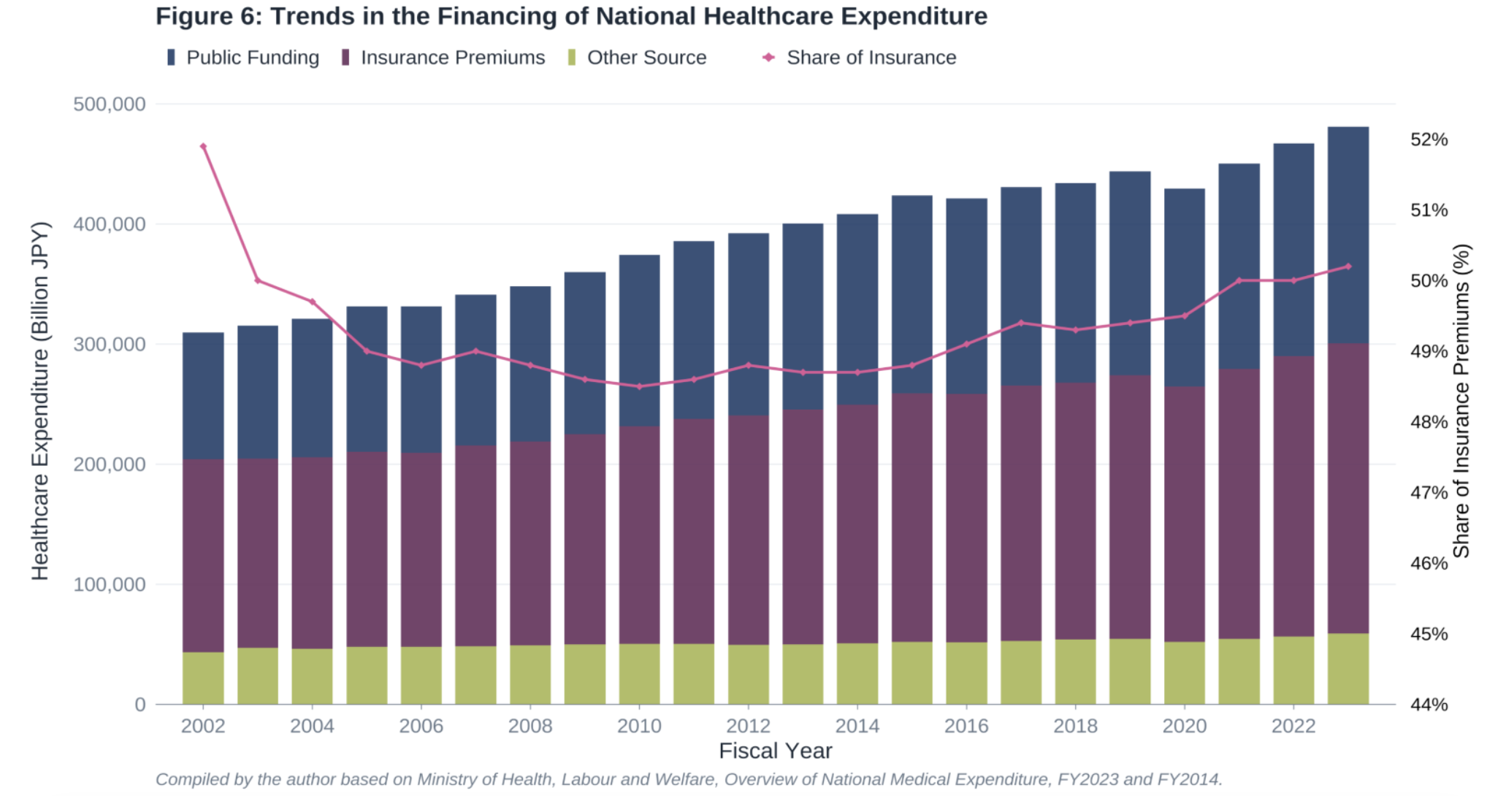
Under such severe fiscal constraints, policymakers face extremely difficult trade-offs, such as “raising insurance premiums,” “increasing public funding (taxes),” “revising (reducing) the scope of benefits,” or “raising out-of-pocket costs.” Currently, premiums account for about half of the funding for national healthcare costs, while public funds account for about 40 percent.³ Meanwhile, although out-of-pocket expenses have remained at around 11–12 percent for the past decade, the pressure on each funding source is nearing its limit as total healthcare costs continue to rise. The residual is borne by patients through copayments, which are rising faster as a percentage of the total than either premiums or public funding.
1.3 An Illusion of Stability
From the patient’s perspective, Japan’s healthcare system remains highly accessible and comparatively affordable. Yet the cost structure sustaining that access is weakening. Studies in healthcare economics⁴⁵ indicate that healthcare spending tends to grow faster than GDP. In Japan, rapid aging further compounds this dynamic, as the demand for healthcare is likely to rise quicker than in other developed countries.
This imbalance fuels mounting political anxiety about the preservation of free access to quality healthcare. Voters broadly support universal access and may fear that higher copayments will limit access to care for those with fewer resources.⁶⁷ At the same time, blanket tax increases remain deeply unpopular in an environment of stagnant real wages, while reducing quality of service to cover increasing costs tends to cause public outrage.
The core reform challenge is not simply cost containment, but how Japan can preserve access, affordability, sustainability, and quality under binding fiscal and demographic constraints. Any financing reforms that sacrifice quality in pursuit of affordability are unlikely to endure politically. Likewise, solutions that focus narrowly on cost reduction through drug price cuts and other measures, without addressing legitimacy and burden sharing, risk undermining public trust and incentives for innovation.
The fundamental challenge of healthcare reform goes beyond mere cost containment. It lies in how to maintain access to healthcare, affordability, sustainability, and quality under severe fiscal and demographic constraints. Funding reforms that prioritize reducing the financial burden at the expense of healthcare quality will fail to gain public support and lack sustainability. Similarly, solutions that focus solely on symptomatic cost-cutting measures—such as lowering drug prices—without addressing fundamental issues regarding the legitimacy of the system and the distribution of financial burdens risk undermining public trust and incentives for innovation.
Section 2: New Sources of Revenue
2.1 The Necessity of New Sources of Revenue
Given Japan’s fiscal limits and competing demands across government sectors, simply redirecting funds to healthcare is neither fiscally viable nor politically feasible. Japan’s general account budget is already stretched across defense modernization, infrastructure maintenance, and debt servicing – the third alone consumes almost 25 percent of annual expenditure in FY2025 and is expected to grow alongside rising interest rates.⁸
In addition to competing demands for government spending, the cost of social security – which covers healthcare, elderly care, pension and welfare in Japan – continues to rise. Social security expenditure has risen from roughly 7 percent of GDP two decades ago to approximately 11 percent today, driven principally by healthcare and long-term care costs associated with population aging. Within the general account budget, social security now accounts for over 33 percent of total expenditure in FY2025. Under current projections, total social security costs are expected to continue rising through 2040.⁹
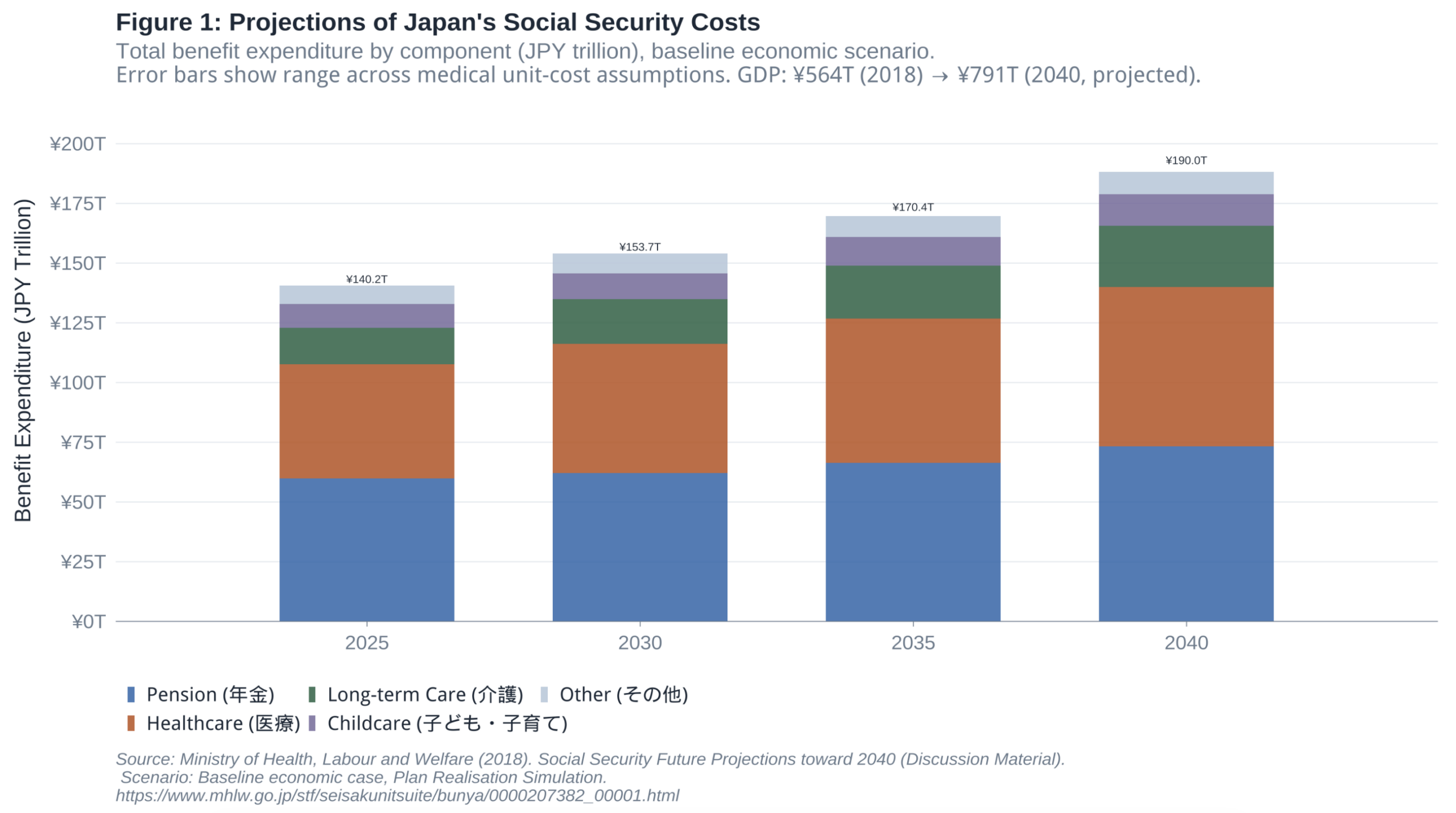
Public debt already exceeds 250 percent of GDP on a gross basis and higher interest rates have added costs to debt service.¹⁰ While domestic annual budget balances have been improving, the trend could reverse as geopolitical tensions may push defense spending higher. In this context, funding expansion through deficit spending carries compounding long-term risks.
To address the current need for more healthcare funding, Japan must evaluate new revenue through tax- or contribution-based mechanisms, each of which involves distinct fiscal, administrative, and political trade-offs.
2.2 Assessing the Viability of New Funding Options
2.2.1 Alcohol and Tobacco Taxes
Alcohol and tobacco taxes are among the most widely used instruments for generating dedicated health-related revenue in developed economies. The policy rationale combines two objectives: generating revenue and shifting healthcare costs of tobacco and alcohol-related illnesses onto consumers.
In the Japanese context, these taxes already contribute meaningfully to general revenue, though they are not currently earmarked for healthcare.
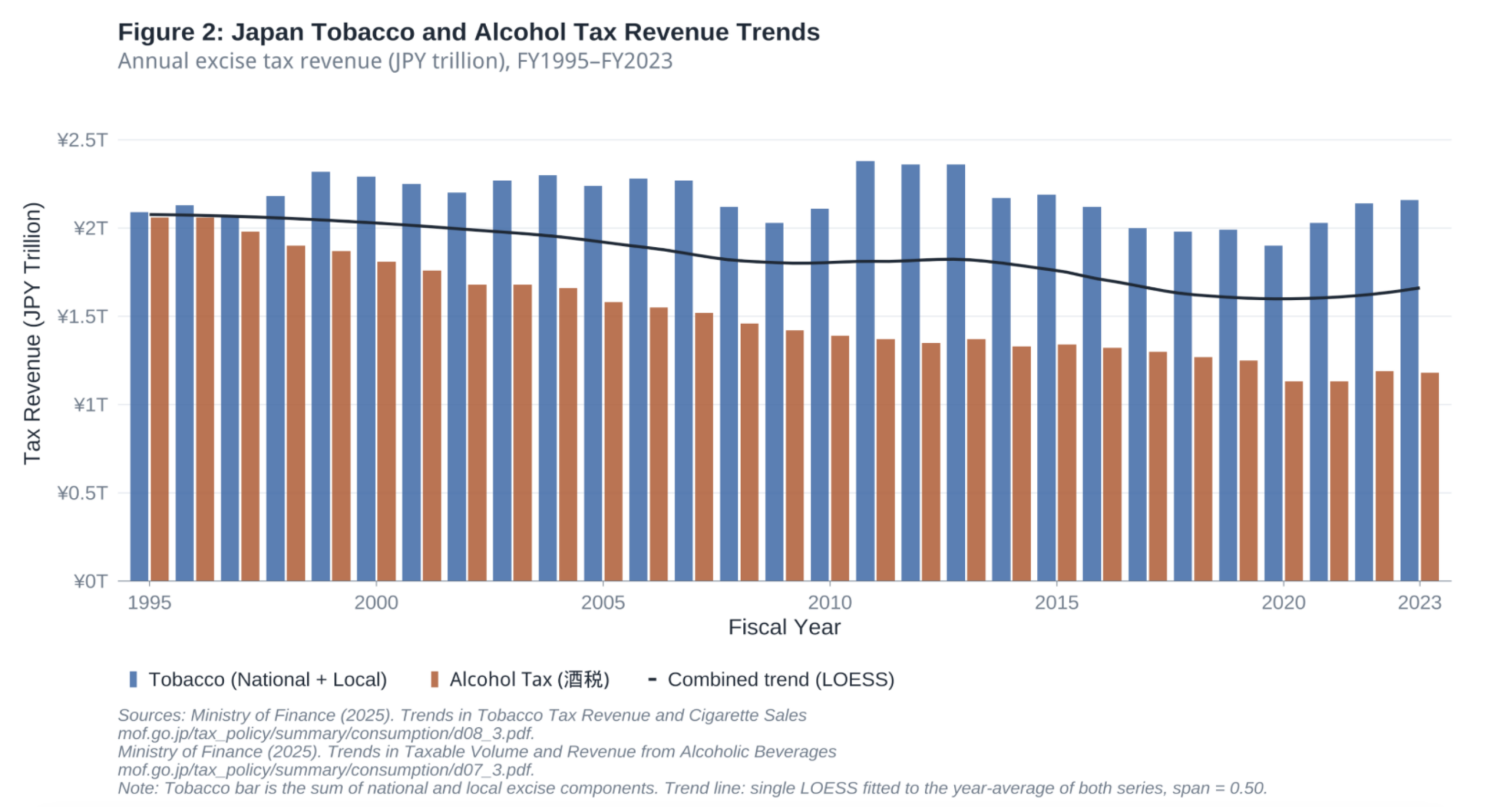
Combined revenue from national and local tobacco levies rarely falls below JPY 2 trillion. In 2023, it was JPY 2.15 trillion.¹¹ Academic analysis suggests this stability is not incidental, as the Ministry of Finance (MOF) may have historically calibrated tax rates to maintain this revenue floor as unit sales declined.¹² One study using 37 years of data (1985–2021) found that the most plausible minimum revenue target explaining the timing of Japanese cigarette tax increases was JPY 2 trillion.¹³
Notwithstanding this revenue floor, the long-term structural trajectory is one of decline. Japan’s adult smoking rate has fallen from above 35 percent in the late 1980s to below 18 percent as of the early 2020s, and annual cigarette sales have dropped from 348 billion units in 1996 to under 100 billion in 2020.¹⁴ A tax specifically dedicated to healthcare would thus face diminishing returns as the base erodes. There is also an internal tension in the ‘sin tax’ model: higher rates are designed to both deter consumption and raise revenue.
Japan’s tobacco pricing remains the second lowest among OECD member countries when adjusted for purchasing power.¹⁵ For example, the price of a 20-pack of cigarettes is only USD 4.78 in Japan, compared with USD 7.33 in the United States, USD 13.21 in the United Kingdom, and USD 20.15 in Australia (which is the highest).¹⁶ Academic commentators have noted that Japanese cigarette prices are approximately one-quarter of the highest OECD price.¹⁷ This suggests there is room for further rate increases before reaching the demand suppression levels seen in high-tax countries, though the political economy of such increases is complicated by Tobacco Inc.’s continued partial state ownership and the close regulatory relationship between the tobacco industry and the MOF.¹⁸
Alcohol taxes present a broadly analogous picture. Japan collected approximately JPY 1.16 trillion (USD 10 billion) in alcohol taxes in FY2023.¹⁹ International evidence suggests that alcohol tax increases can reduce consumption and associated health costs, particularly from liver disease, road traffic accidents, and cancer, while raising revenue. However, as with tobacco, declining per-capita consumption trends mean that reliance on alcohol taxes as a healthcare funding mechanism is inadvisable.
A further structural limitation is the current absence of healthcare earmarking. Increased revenues in these areas have been added to the government’s general account and helped to fund expansion in national defense spending, another priority area.²⁰ Neither tobacco nor alcohol taxes in Japan are formally directed to health promotion or healthcare financing; tobacco tax revenues have in part been allocated to servicing the residual debts of the former Japanese National Railways (JNR), a legacy obligation that further constrains any hypothecation to healthcare.
2.2.2 Tourist Exit Tax
Japan introduced its international tourist tax in January 2019, imposing a departure levy of JPY 1,000 (approximately USD 6.50) on all persons departing Japan by air or sea. In FY2024 (April 2024–March 2025), it generated approximately JPY 52.4–52.5 billion (approximately USD 338–340 million), driven by a post-pandemic surge in inbound tourism that saw Japan welcome approximately 36.87 million foreign visitors in calendar year 2024 – a new annual record and compares with around 31.8 million visitors in 2019.²¹
In January 2026, the government confirmed that the departure tax would be tripled to JPY 3,000 per person, with the increase scheduled to take effect later in 2026. The revenue proceeds from any increase were expected to be primarily directed at overtourism mitigation rather than healthcare.
The revenue potential of an increased exit tax for healthcare is constrained on two dimensions. First, from a revenue standpoint, even a tripling of the rate to JPY 3,000, assuming roughly stable departure volumes, would generate approximately JPY 157 billion annually – a meaningful but still modest figure relative to Japan’s total healthcare expenditure of approximately JPY 46–48 trillion per year (based on FY2023 numbers).²² Second, from an allocation standpoint, the political and institutional momentum behind the tax’s proposed increase is explicitly tied to overtourism responses.
From a healthcare financing perspective, the tourist exit tax has structural limitations as a dedicated health funding instrument. Tourism volumes are vulnerable to geopolitical shocks, exchange rate fluctuations, and global health events, as demonstrated by the near-total collapse of inbound tourism revenues during the COVID-19 pandemic years (FY2020–FY2022), or to the more recent geopolitical issues related to China.
2.2.3 Consumption Tax Increases
Japan’s consumption tax – a value-added tax applied at the standard rate of 10 percent on most goods and services (with a reduced rate of 8 percent on food and non-alcoholic beverages for home consumption) – is the government’s single largest tax revenue source. In FY2025, consumption tax accounted for 21.6 percent of total central government tax revenue, exceeding both personal income tax (19.7 percent) and corporate income tax (16.7 percent).²³ Total consumption tax revenue in FY2025 was approximately JPY 25 trillion.
A defining feature of the Japanese consumption tax is its statutory earmarking for social security. While all consumption tax revenues enter the government’s general account alongside other tax proceeds, they are dedicated by law to social security programs. This design reflects the government’s long-standing position that the consumption tax is the primary instrument for financing demographic expenditure.²⁴
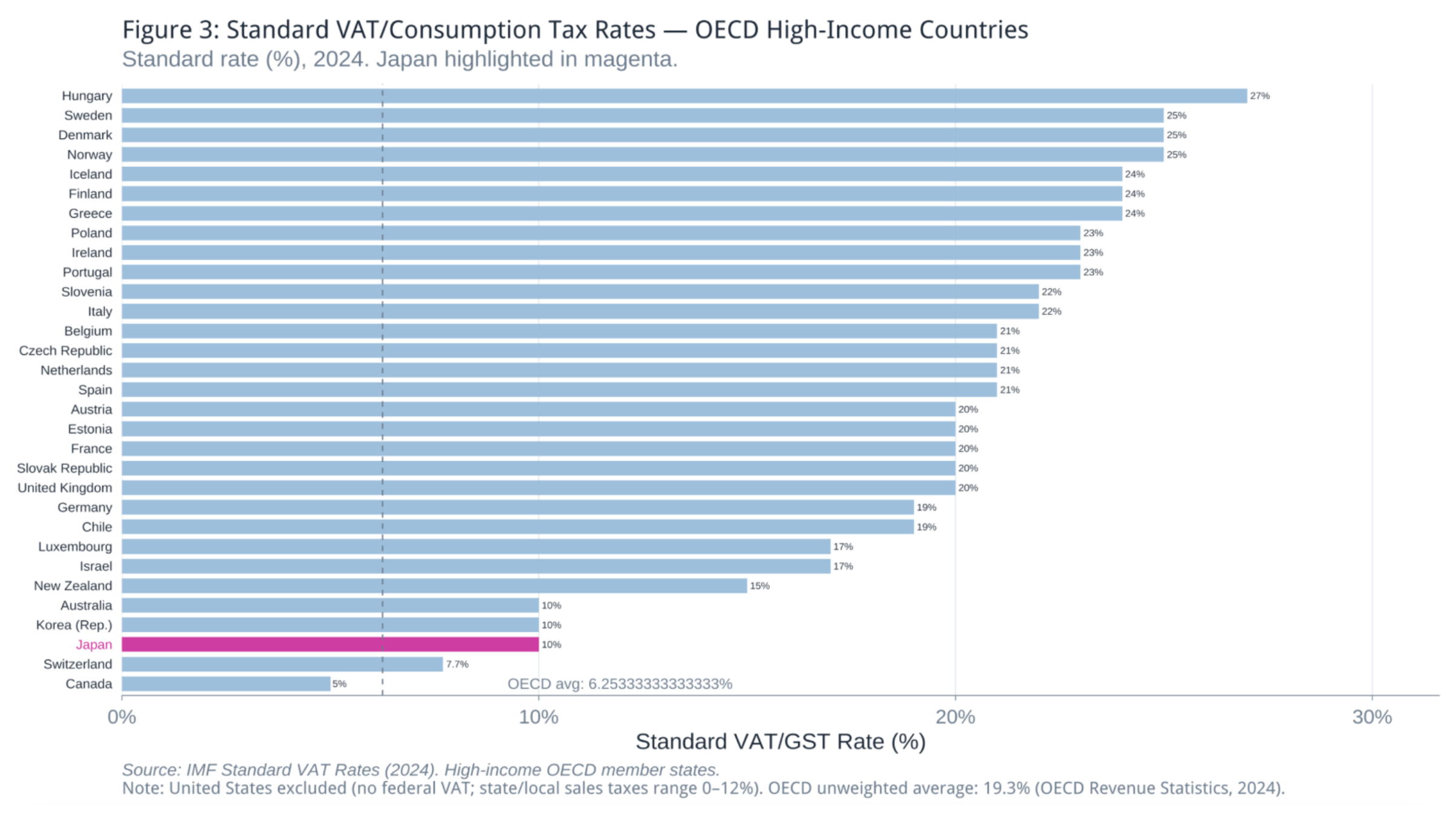
Japan’s consumption tax rate remains substantially lower than comparable advanced economies. The OECD average standard VAT rate for FY2024 sits at over 19 percent, meaning that Japan’s 10 percent rate is almost half.²⁵ International Monetary Fund (IMF) analysis noted that raising the consumption tax from its current 10 percent to 15 percent could provide a significant share of the fiscal adjustment required to place Japan’s public finances on a sustainable medium-term trajectory.²⁶
Many economists consider the consumption tax to be one of the most growth-compatible tax instruments available, since it does not directly tax labor income or investment returns. It is also relatively stable across economic cycles, as household consumption tends to be less volatile than corporate profits or investment income.
The principal distributional concern is regressivity. Since lower-income households spend a larger proportion of their income on consumption, a flat-rate consumption tax imposes a higher effective burden on the poor than on the wealthy. This is partially mitigated in Japan by a reduced 8 percent rate on food and non-alcoholic beverages, introduced alongside the 2019 increase to 10 percent. IMF analysis of Japan’s tax system has proposed that the regressivity of consumption tax increases could be further offset through income redistribution and targeted cash transfers.²⁷
The political economy of further consumption tax increases is formidable, though. The tax was introduced in 1989 at 3 percent and raised to 5 percent in 1997, 8 percent in 2014, and 10 percent in 2019 – each increase preceded by extended political conflict and delayed multiple times.²⁸ The 2014 increase contributed to a recession, and subsequent increases were postponed twice. Multiple recent prime ministers have explicitly ruled out further increases during their terms, and no mainstream political party is actively campaigning for a consumption tax increase.
2.2.4 Corporate Income Tax
Corporate income taxes generated approximately JPY 20 trillion in FY2025, accounting for roughly 16.7 percent of general government revenue.²⁹ Japan’s statutory combined corporate tax rate – including national corporate tax, local corporate tax, and enterprise tax – stands at approximately 31.52 percent as of 2024.³⁰ This effective combined rate, while not the highest in the OECD, places Japan above the G7 average and considerably above rates in jurisdictions competing for foreign direct investment such as Ireland (12.5 percent) and Singapore (17 percent).
Japan’s repeated corporate tax cuts have disproportionately benefited large corporations and their shareholders, while increases in the consumption tax have raised costs for ordinary households. Critics of current policy contend that corporate tax cuts were premised on firms reinvesting profits in wages and domestic investment – a premise that, according to the government’s own policy documents, has not been fully realized, with corporations instead accumulating retained earnings, or investing in facilities and assets abroad.³¹
There are significant countervailing concerns about raising the corporate tax rate. The most fundamental is the effect on investment and capital mobility. In an open economy, higher corporate tax rates can induce firms to shift profits or operations to lower-tax jurisdictions. Japan’s low foreign direct investment inflows reflect in part the perceived cost of operating in Japan, of which taxation is one component.³²
The prevailing government preference across the 2010s and into the mid-2020s was to pursue targeted tax incentives for wage growth and investment rather than rate increases – a posture maintained through the Kishida and Ishiba administrations. Though Takaichi broke with past policy and approved increases to fund defense spending, she is also promising substantial subsidies for growth-sectors, meaning further increases specifically to cover healthcare expenses is unlikely.
2.2.5 Retained Earnings Tax
Proposals to tax corporate retained earnings draws on a specific feature of Japan’s corporate landscape: the sustained accumulation of idle cash and deposits by large firms. From 2000 to 2020, corporate retained earnings in Japan grew substantially even as capital investment remained subdued and wage growth stagnated. Council materials prepared for the Kishida administration’s ‘new capitalism’ advisory council (2021–2024) documented that retained earnings had mushroomed over this period, even as worker compensation and domestic investment fell as a share of corporate income.³³ This behavior has its roots in Japan’s post-bubble restructuring of the 1990s, accelerated by the shock of the Asian Financial Crisis (1997–98), which instilled a deep corporate preference for liquidity over investment that has persisted for more than two decades.
The policy rationale for a retained earnings tax is both fiscal and behavioral. Fiscally, it would access a large pool of accumulated corporate funds. Behaviorally, it could create an incentive for firms to deploy retained earnings rather than accumulating them passively. This objective of shifting corporate behavior toward investment and distribution remains a stated policy priority.
An important international comparator is South Korea’s Corporate Income Feedback Tax (CIFT), enacted in 2015 in response to similar concerns about corporate hoarding amid wage stagnation.³⁴ The CIFT imposed a 10 percent surtax on companies failing to deploy at least 80 percent of their after-tax profits through investment, wages, or dividends. Approximately one-third of the 3,000 companies in scope paid additional taxes. Analysis of this experiment concluded, however, that the policy’s impact on corporate behavior was limited. Most firms preferred to pay the surtax rather than fundamentally alter their earnings deployment strategies.³⁵
From a tax policy standpoint, a retained earnings tax raises the concern of double taxation, as corporate income is already taxed under the corporate income tax when earned. Taxing retained earnings on accumulated balances implies that corporate income that was lawfully retained – potentially for genuine business purposes such as investment reserves, risk buffers, or R&D – is taxed a second time.
2.2.6 Asset-Linked Insurance Premium Increase
Under Japan’s existing framework, social insurance premiums are calculated primarily on labor income (wages and salaries). Financial income is generally excluded from the base for social insurance contribution calculations for employer-sponsored plans, which cover a great majority of the population.
This creates a significant asymmetry, as high-net-worth households, whose income is predominantly financial or asset-based, contribute proportionately less to the social insurance system than those whose income consists primarily of wages. Cabinet Office data from 2024 showed that high-asset households – those in the top income and savings deciles hold average savings of JPY 21 million compared to JPY 11.4 million for younger, working age households.³⁶
An IMF analysis of Japan’s distributional tax landscape notes that capital income is taxed at a flat 20 percent rate, which is considerably lower than the top marginal income tax rate of 45 percent.³⁷ This creates an implicit subsidy to asset holders over labor income earners. An increase in the capital income tax rate, or its inclusion in the social insurance contribution base, would improve the progressivity of the overall tax and contribution system.
Assessing and taxing financial income that may be held in complex instruments, offshore accounts, or tax-favored vehicles (such as the Nippon Individual Savings Account, or NISA) requires robust data infrastructure and cross-institutional data sharing. There are also concerns about behavioral responses, such as high-net-worth individuals restructuring holdings to avoid the tax, shifting assets to tax-exempt vehicles, or in extreme cases relocating to jurisdictions with more favorable tax treatment. This is a behavior already observed in Japan, where wealthy individuals have relocated to Southeast Asian countries such as Singapore or Australia to reduce tax burdens.³⁸
A comprehensive asset or financial income tax would likely face resistance from affluent individuals. Conversely, younger voters and labor representatives may view it favorably, as it addresses the perceived unfairness of a system that taxes wages heavily while leaving financial returns relatively undertaxed. The political sensitivity around this proposal was starkly illustrated by the so-called ‘Kishida shock’ of October 2021, when then-Prime Minister Fumio Kishida’s initial proposal to raise capital gains and dividend taxes triggered an immediate stock market sell-off, forcing a rapid policy reversal.³⁹
2.2.7 Expanding Employer Premium Contributions
Japan’s public health insurance system is divided into two principal schemes. The first, employer-sponsored health insurance (kigyō kenkō hoken, also known as kenpo), covers employees of companies above certain size thresholds and is jointly financed by employer and employee contributions, calculated as a percentage of monthly salary. As of FY2023, approximately 40 million workers and their dependents are enrolled in some form of employer-sponsored health insurance, administered either through company-specific health insurance societies (kenpō kumiai) for larger firms or through the Japan Health Insurance Association (Kyōkai Kenpo) for smaller ones.⁴⁰
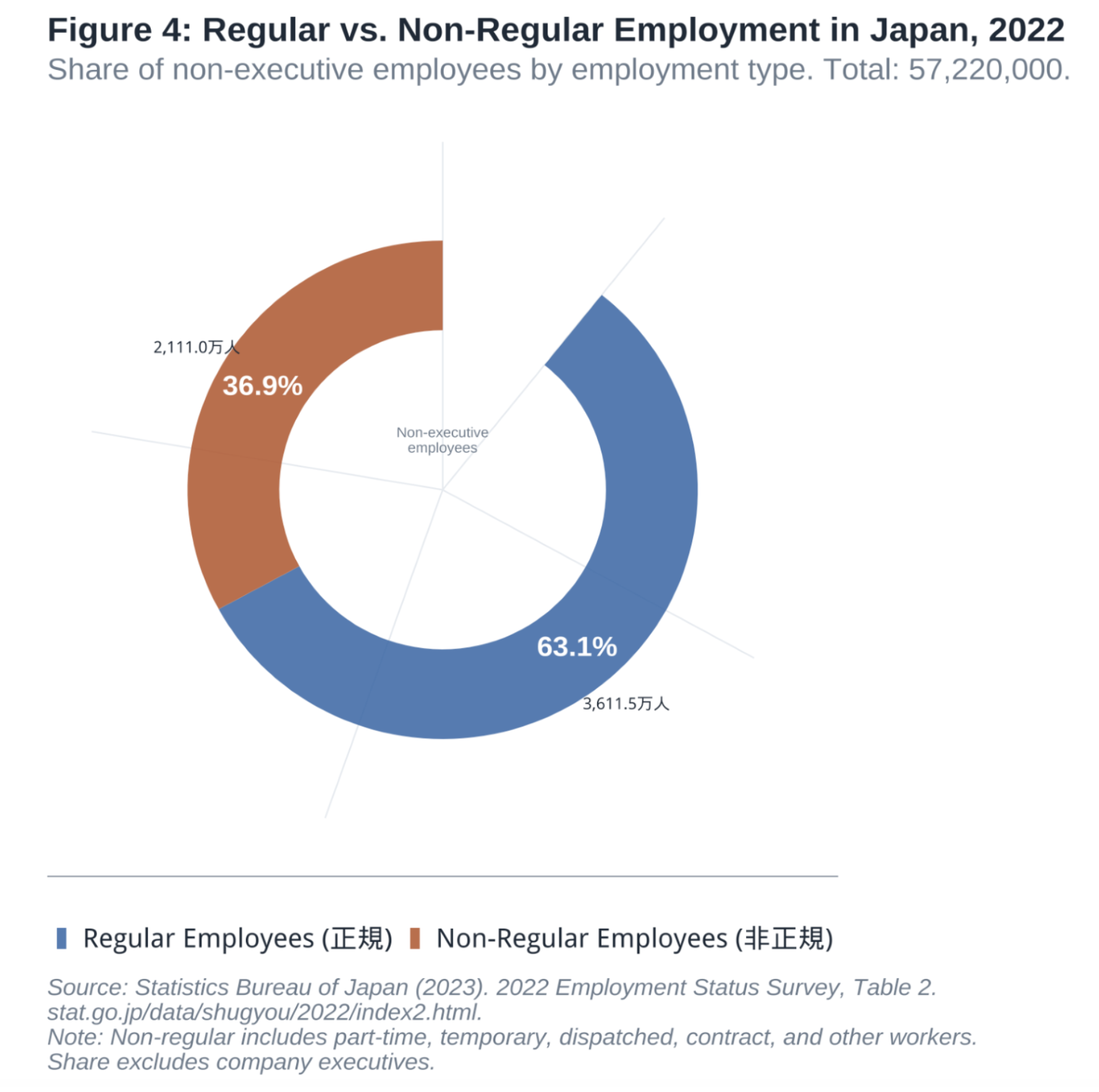
The second scheme, National Health Insurance (kokumin kenkō hoken, NHI), functions as the residual system for those not covered by employer-sponsored insurance – including the self-employed, agricultural workers, retirees under 75, and, critically, many non-regular workers. The non-regular workforce now accounts for approximately 37 percent of all employed persons in Japan, a substantial increase from roughly 20 percent in the early 1990s.⁴¹ As of FY2023, approximately 27 million people are enrolled in the NHI. As NHI has no employer contribution component, enrollees bear the full premium burden themselves.⁴²
Expanding employer premium contributions could proceed along several dimensions: broadening mandatory coverage to more non-regular workers, raising the employer share of the premium split, or calibrating firm-level contribution rates to financial capacity. Of these, Japan has made the most progress on coverage expansion. The employer size threshold for mandatory enrollment was progressively lowered from firms with 500 or more employees (2016) to 100 or more employees (October 2022) and further to 50 or more employees (October 2024).⁴³ The 2022 expansion was projected to enroll an additional 450,000 workers, and the 2024 expansion a further 200,000.
Abolishing the company-size threshold entirely or expanding mandatory coverage to include workers based purely on hours worked rather than employer size would extend the coverage of employer-sponsored plans to a much larger population. In parallel, the 2025 Pension Amendment Act includes provisions to abolish the ‘1.06-million-yen annual income barrier’ (a threshold below which spousal dependent coverage applies), which has been cited as a major incentive for married women to limit their working hours to avoid triggering obligations to pay social security premiums.⁴⁴
Two further mechanisms could raise employer contributions without extending coverage. First, while premiums are currently split evenly between employers and employees, the 50:50 arrangement is not legally set, and the employer share could be increased. Second, contribution rates could be calibrated to firm-level financial strength rather than applied as a uniform percentage of payroll, so that more profitable or better-capitalized firms would bear a larger share of system financing.
The healthcare financing implications of expanded coverage are twofold. First, expanding the employee insurance contribution base increases premium revenues collected by health insurance associations, expanding the pool of funds available for cross-subsidization of the system’s more costly segments. Second, the shift of non-regular workers from the NHI scheme to employer-sponsored health insurance reduces pressure on municipal NHI finances, which have been chronically underfunded.
The distributional and equity arguments for expansion are strong. Non-regular workers, who are disproportionately women, younger adults, and those in low-wage service sectors, currently bear a heavier effective contribution burden per yen of income under the NHI compared to regular employees of similar income. This is because NHI does not include employer contributions.
Unlike the more politically contested options discussed elsewhere in this section, expanding non-regular worker coverage is likely to have broad political support. The main unresolved question is not whether to expand but how far and how quickly; specifically, whether full removal of the employer-size threshold is economically viable in the near term given concerns about small business burden.
2.2.8 ‘One-Coin’ Patient Co-Payment
Under the standard framework, most working-age adults pay 30 percent of medical costs as a co-payment,⁴⁵ with most elderly patients paying less. This architecture, while equitable in intent, has been associated with a pattern of high and potentially excessive utilization, particularly among the elderly and in non-emergency settings.
The phenomenon of ‘KONBINI doctor visits’⁴⁶ – casual, non-urgent visits to medical facilities (including holiday and night emergency services) by patients who treat medical care as a convenience-store-like service available on demand. This phenomenon arose from the introduction of nearly free elderly care, following the introduction of free healthcare for those aged 70 and over in 1972. Though later revisions have reinstated contributions of up to 30 percent for higher-income seniors, at least one former MHLW official described this as among the most consequential policy miscalculations in the system’s history.⁴⁷
In this context, a proposal for a flat co-payment charge of JPY 500 per medical visit could address overutilization while generating supplementary revenue. The JPY 500 figure is a modest out-of-pocket payment relative to average medical costs and is designed to be low enough not to deter necessary care, but sufficient to discourage casual or unnecessary visits.
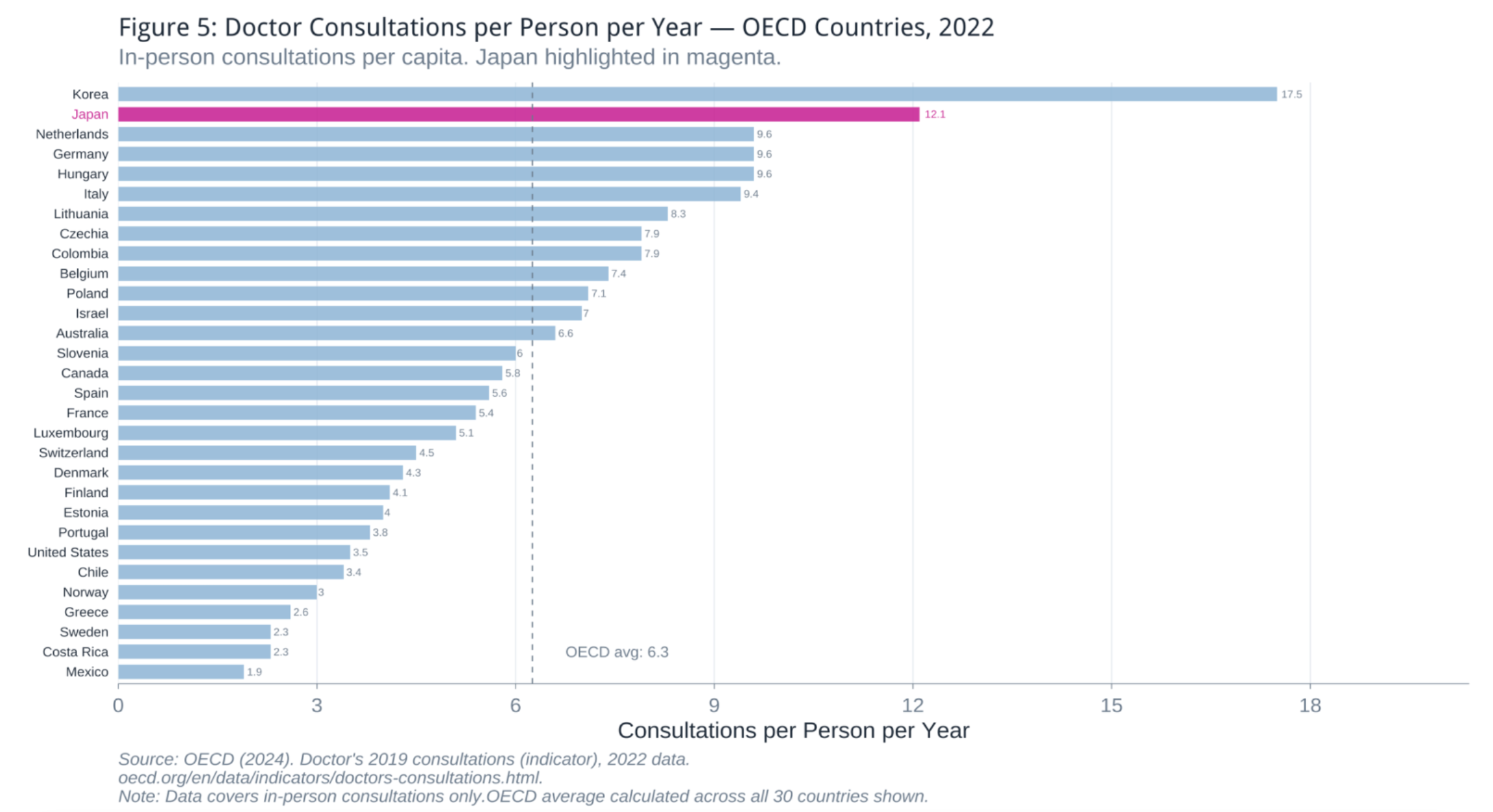
Japan’s average number of doctor visits per capita outpatient visits have been estimated at approximately 12–13 per year, the second highest, compared to the OECD average of roughly 6–7 visits.⁴⁸ This utilization pattern is not solely attributable to moral hazard – Japan’s aging population has genuine healthcare needs, but the literature on Japan-specific moral hazard consistently finds that removing or reducing co-payments increases utilization beyond what health need alone would predict.⁴⁹
The primary political and distributional objection to a universal flat co-pay is that opponents could characterize it as a de facto tax on the sick and aged. Evidence on co-payment elasticity shows that while average utilization falls, the decline is concentrated among lower-income and less healthy patients, who may be deterring genuinely needed care alongside unnecessary visits. This concern has been a significant barrier to co-payment reform in other political contexts.
International comparisons offer instructive design precedents. Germany’s ‘practice fee’ (Praxisgebühr),⁵⁰ a EUR 10 quarterly co-payment for general practitioner (GP) visits. It was introduced in 2004 and abolished in 2013, with evidence suggesting it reduced GP visits but also deterred necessary care among lower-income patients. South Korea used variable co-payment rates by facility type to steer patients toward primary care, with measurable effects on tertiary care utilization.⁵¹ These experiences suggest that flat co-payments are a blunt instrument and that more targeted designs may better balance utilization management with access protection.
Section 3: Expanding Insurance Premiums Based on Assets
3.1 A Reexamination of the Insurance Premium Assessment Basis Based on the Principle of “Ability to Pay”
Given the range of options assessed in this paper, a comprehensive solution to Japan’s healthcare financing gap will ultimately require several measures in concert. However, not all options are equally viable in the near term. Consumption tax increases, while fiscally significant, face deep and well-documented political resistance. Corporate tax hikes risk undermining investment and triggering capital flight. The current political climate favors that any increase to these taxes should be put toward funding increased defense expenditure. Sin taxes and tourist levies, while politically accessible, are limited in scale. The goal, therefore, is to expand the tax base to include these sources. This is a challenge common to both public funds (taxes) and insurance premiums, with the aim of moving away from a structure that relies solely on existing labor income by strengthening taxation on “stock assets” (such as financial income, dividends, and real estate income).
Insurance premiums for Japan’s employer-sponsored programs are tied to earned income, meaning that as the workforce shrinks and wages stagnate, the premium base grows more slowly than the healthcare costs it is meant to fund. This mismatch is compounded by demographic aging; as the ratio of retirees to active workers rises, fewer contributors support a larger and more expensive pool of beneficiaries. The result is a system where premium revenues track the fortunes of the labor market rather than the actual cost of care. As a result, the gap between healthcare expenditure needs and premium revenue is widening quickly, straining the ability of the government to pay for the increased costs of the healthcare system.
Under the employer-sponsored system, premiums currently average roughly 10 percent of wages, split evenly between employee and employer, and are capped once monthly standard remuneration reaches JPY 1,390,000 (USD 8,700) – beyond which all additional earnings attract the same maximum contribution. ⁵² Income from financial and real estate assets – interest, dividends, capital gains, rental income – is excluded from this calculation. Expanding the contribution base to capture these income flows would better reflect their true economic capacity. For employers, it could introduce a more meaningful link between corporate financial capacity and social insurance obligations.
Under the NHI, premiums are paid entirely by the household with no employer contribution and are capped at JPY 1.09 million annually in FY2025 – a ceiling typically reached around JPY 11-12 million in annual household income.⁵³
The NHI has historically included a mechanism that partially links premiums to asset holdings. Under the traditional four-component NHI premium structure, municipalities can calculate contributions based on some combination of income (shotoku-wari), assets (shisan-wari), a per-capita levy (kintō-wari), and a per-household flat rate (heimei-wari).⁵⁴ The income-based portion uses the household’s prior-year taxable income, meaning it can reflect not only wages but also other taxable income, such as business income, interest, dividends, and capital gains, depending on local rules. However, the asset-based component was typically calculated as a percentage of the fixed asset tax (kotei shisan zei) paid by the household, meaning that property ownership was already, in principle, incorporated into NHI contribution calculation. The use of fixed asset taxes in determining NHI premiums has largely been phased out in recent years, due in part to concerns about fairness compared with the employer-based system, which only considers wages.
The proposal presented in this paper is to include income derived from assets (such as investment income) in the tax base for insurance premiums for both employees (subscribers) and employers. Rather than directly taxing the assets themselves, the proposal targets the income streams generated by those assets and utilizes a portion of that income as a funding source for the social insurance system.
Asset-derived income for corporations is less straightforward. Such a levy could operate as a supplementary social contribution calculated on financial income, layered on top of existing employer health insurance obligations and calibrated to reflect the gap between corporate financial accumulation and the comparatively modest growth in employer contributions.
Expanding the premium calculation to include income flows generated from assets is administratively feasible and fiscally justified, despite some challenges. The relevant income streams include interest and dividend income, realized capital gains, rental income, income from side activities, and stock-option-related income. Including these would better reflect an individual’s or company’s true capacity to contribute to the system – and will make it possible to correct irregularities and ensure that social insurance contributions are based strictly on ability to pay.
Linking contributions more closely to financial assets held by employees and employers would significantly strengthen the stability of Japan’s health insurance system. As universal coverage requires all residents to enroll, with roughly 60 percent in employer-based plans and the remainder in the NHI or the Medical Care System for the Latter-stage Elderly, expanding the contribution base for the employer-sponsored programs would have particularly strong impact. ⁵⁵
3.2 Reducing Disparities – The Case for Individual Asset-Based Contributions
In public discourse, tax increases on the wealthy and corporations are frequently proposed. However, Japan’s corporate tax rate is already high by international standards, and regarding income tax, the top marginal rate reaches 55.945% when local taxes are included (45 percent income tax + 10 percent resident tax + Special Income Tax for Reconstruction). This is an extremely high level even when compared to other G20 countries with universal health insurance systems, such as France, Germany, and the United Kingdom, and there is limited room for further increases. ⁵⁶ On the other hand, while tax rates for low-income earners are kept relatively low, it would be extremely difficult to gain public support for imposing further burdens on middle- and low-income earners, including through a consumption tax hike. ⁵⁷
Targeting asset-based income, therefore, offers a fair alternative that refines the principle of ability-to-pay,, and would also serve a redistributive function – shifting the burden of maintaining health insurance programs toward wealthier groups while easing pressure on wage earners.
The new focus on asset-derived income may face two objections. The first is political, as high-net-worth individuals are likely to oppose any measure that directly targets their investment returns. It could also be characterized as punishing savings and discouraging the very household asset accumulation that the government has encouraged.
The second is administrative. Japan currently lacks the necessary administrative systems and supporting infrastructure to comprehensively track individuals’ assets. In contrast to the United States – where Social Security Numbers serve as a cornerstone for integrating financial, healthcare and tax records across the market – Japan’s My Number system is only partially connected among government agencies and financial organizations. As a result, the country’s administrative framework does not yet enable seamless asset tracking or unified information management.
Creating and enforcing the necessary data framework would require reliably connecting financial, health insurance and pension accounts to My Number identifiers, beginning with savings and investment accounts. Political resistance from both the political establishment, and ordinary Japanese voters complicates such an endeavor, as many hold deep concerns about privacy and data security.
3.3 Increasing Corporate Contributions
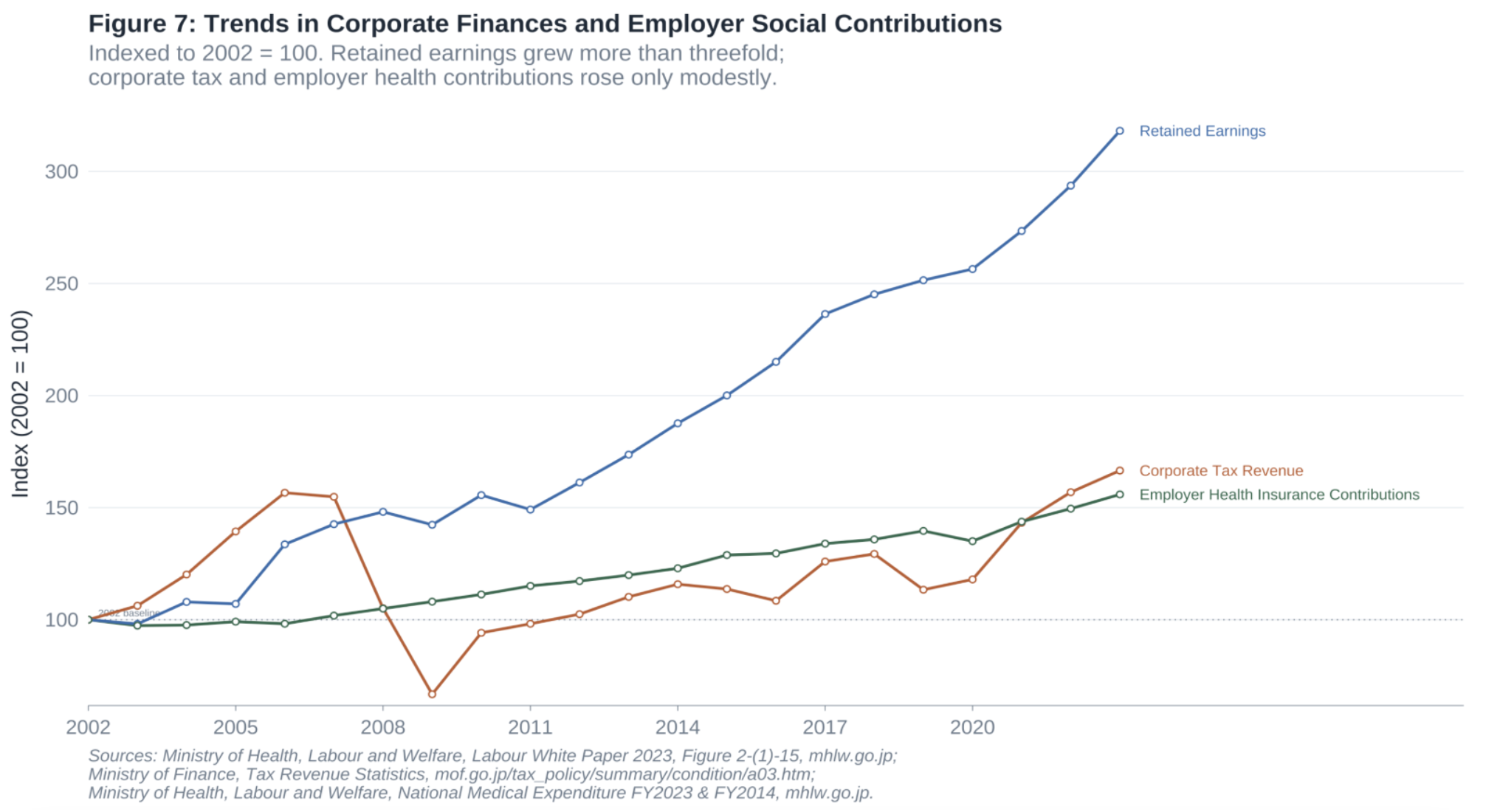
Corporate contributions to social security have not kept pace with rising corporate profits and asset accumulation. Figure 7 illustrates the divergence. Between 2002 and 2023, employer health insurance contributions rose from JPY 6.8 trillion to JPY 10.6 trillion, an increase of roughly 56 percent. Meanwhile, corporate retained earnings – earnings that companies keep on their balance sheets rather than paying out as dividends or investing – grew from approximately JPY 189 trillion to over JPY 600 trillion – more than tripling in two decades. In other words, retained earnings grew at nearly five times the rate of employer health contributions over this period.
Total financial assets held by non-financial corporations reached JPY 1,673 trillion as of December 2025, more than doubling over the past two decades and outpacing the growth in employer social insurance contributions over the same period.⁵⁸ Corporate tax revenue, meanwhile, fluctuated sharply with the economic cycle, falling by nearly a third during the 2008–2009 financial crisis before recovering, and ending 2023 at approximately JPY 15.9 trillion – a 66 percent nominal increase from 2002.
Higher corporate tax rates raise concerns about diminishing economic growth and competitiveness, and a portion of corporate tax revenues are already being earmarked for defense spending. Additionally, corporate tax rates are already high. In Tokyo, the effective corporate income tax rate can reach as high as 35.43 percent, with an average rate of approximately 29.7 percent, varying by the size of a firm’s paid-in capital when accounting for both national and local levies. ⁵⁹ Corporations in New York City, by comparison, are only charged 17.5 percent.
Taxes on retained earnings face distinct challenges, as they could be characterized as double taxation, as mentioned in Section 2.
The most politically and economically viable method in the short- to mid-term would be to increase company contributions to social security programs by accounting for companies’ income generated by assets. This could either be through tracking asset-income and adding a levy, or by leveraging corporate contributions to employer-sponsored health insurance programs and pension schemes. This means that increasing the ratio of a company contributions is administratively possible. In other words, raising the employer’s contribution rate, by adding a “wealth premium” to the corporate share of the burden, or raising the contribution cap specifically for the corporate share could serve as effective measures to rationalize the burden while avoiding complex system reforms. A further advantage of this system is that, because the rates can be set and adjusted flexibly, it is possible to raise only the employer’s contribution rate while maintaining the employee’s contribution rate at its current level.
Returning to the principles of social insurance, the fundamental method of securing funding lies in raising premium rates; however, achieving consensus on a uniform increase is difficult. Therefore, raising the contribution ratio for employers – who have relatively greater capacity to bear the burden (in terms of corporate profits and retained earnings) – by revising the principle of equal sharing between labor and management is a legitimate and realistic measure for securing funding.
This approach would broaden the contribution base without introducing new tax instruments, and it would align contribution levels more closely with firms’ true financial capacity.
Conclusion
In response to the structural challenges facing Japan’s healthcare system, new revenue sources are urgently needed to preserve access, affordability, and quality. In this context, our investigation found that the most socially equitable, politically acceptable and viable from a long-term funding perspective was to add asset-based income to premium calculations for health insurance schemes.
In Section 2, we discussed eight proposals for new healthcare revenue, ranging from earmarking tobacco and alcohol taxes to implementing higher consumption taxes, or even new types of co-payments. Each had their own advantages and drawbacks, which ranged from administrative complexity to political unviability. Some merit further discussion as supplemental policies, such as the one-coin co-payment, or increasing the rate of sin taxes. These could moderately increase revenue, but they may also reduce use of the healthcare system, another goal that could ensure the long-term fiscal health of the system.
Other tax-based methods face strong political opposition. In fact, though increasing the consumption tax would provide significant revenue, and even though Japan’s consumption tax is low compared to other states, any increase is extremely challenging because of strong voter opposition and a lack of will among most politicians.
Implementing asset-linked premiums is not without challenges. For example, it will require administrative reforms, which are necessary for the accurate reporting of asset-based income for individuals and companies. For individuals, this can be done by expanding the use of the My Number system, which may face political pushback.
Finally, for these recommendations to be implemented, the next step is to translate them into actionable policy proposals. This will involve engaging lawmakers, relevant ministries, industry associations, and patient advocacy groups to refine the framework, address technical concerns, and build the consensus required for durable reform.
Authors:
Michael J. Gigante is an Associate at the Asia Group, located in Washington, D.C., where he covers energy and pharmaceutical policy. Michael is the author of Factional Politics in the Liberal Democratic Party: Explaining Change and Continuity in Japan’s Economic Statecraft, which was published by Cambridge University Press, and is completing a Ph.D. in Political Science at George Mason University.
Hana Anderson is an Associate at the Asia Group’s Tokyo office, where she works on issues related to Japan’s pharmaceutical and technology industries. She has held roles across the Japanese Diet, DC-based think tanks, and U.S. State Department, focusing on U.S.-Japan alliance issues.
Yuka Hayashi is a Vice President at the Asia Group, located in Washington, D.C. She was previously a journalist for The Wall Street Journal for two decades, covering economy, business and geopolitics from Tokyo and Washington.
Reviewer:
Ambassador Teruyuki Katori is a Senior Advisor at The Asia Group and a former senior official at the Ministry of Health, Labor, and Welfare. He served as Director‑General overseeing social security, pension policy, employment and gender equality, and policies related to children and families.

Media
Commentary
Stabilizing Japan’s Healthcare System: Proposals for New Funding Sources
Summary
This paper was developed in collaboration with the individuals listed below (in alphabetical order), who are top authorities within their respective fields. While the findings presented herein are informed by collective discussions with these experts, the opinions, recommendations, and final conclusions expressed are solely those of the authors and do not represent the personal views of the consulted experts.
Mamoru Ichikawa, Health journalist and Musashi University Associate Professor
Yukiko Ito, Professor, Faculty of Commerce, Labor and Society; Keio University
Katsufumi Jou, Senior Advisor, Boston Consulting Group, Former Ministry of Health, Labor and Welfare Director General
Ryoji Noritake, Chair, Health and Global Policy Institute
Koji Yano, President of Institute of Social Security Policy, International University of Health and Welfare, Former Vice-Minister of the Ministry of Finance
View the executive summary here.
View the full report PDF here.
Introduction
Rising medical costs, rapid population aging, and sluggish economic growth are undermining the fiscal foundation that has supported the universal health insurance system, and pressure on Japan’s social security system is greater than ever before. The traditional funding structure – comprising out-of-pocket payments, insurance premiums, and public funds – has reached its limits. This not only imposes an excessive burden on the working-age population but also narrows the government’s fiscal options, threatening the very existence of a system designed to provide equal access to medical care for all. With social security expenditures accounting for one-third of the national budget and existing revenue sources failing to keep pace with growing demand, Japan faces a critical challenge: how to develop new revenue-generating measures that transcend the current framework and maintain sustainable, high-quality healthcare.
Section 1: The Fiscal, Economic and Political Context of Healthcare Reform in Japan
1.1 Japan’s Healthcare Burden Sharing
When discussing healthcare system reform in Japan, it is first necessary to situate healthcare costs within the broader framework of the “three pillars” of public burden and social security. While Japan’s system is fundamentally based on the social insurance model (mutual aid), it also operates a mechanism that involves substantial public funding (public assistance). This model differs from the tax-based systems seen in the United States, the United Kingdom, and the Nordic countries, which rely heavily on private funding. It also stands apart from Germany and France, which, while adopting the same social insurance model, limit public funding.¹
For many years, Japan’s universal health insurance system has been based on the principle that all members support the system. This logic was premised on relatively small income disparities, a substantial middle class (i.e., working-age population), a stable demographic structure, and robust economic growth. However, as we now face widening disparities, an inverted population pyramid, and economic stagnation, these premises have collapsed. Under these circumstances, maintaining the traditional burden-sharing structure has become extremely difficult in terms of both building social consensus and managing public finances.
Consequently, reforming healthcare financing goes beyond mere adjustments to fiscal figures; it is also a matter of redefining the “equitable distribution of burdens and benefits.” Specifically, it raises the question of how to ensure fairness in the distribution of burdens between the working-age and elderly generations, as well as according to income and asset levels. As the aging of the population accelerates, the reality is that the working-age generation is shouldering ever-increasing burdens while harboring anxieties about the future sustainability of the system.
1.2 The Urgency of Reform
The urgency of confronting the sustainability of Japan’s healthcare financing stems from Japan’s General Account budget. In FY2025, total expenditures are projected at approximately JPY 115.2 trillion (USD 748 billion),² with social security spending consuming roughly one third and debt servicing nearly a quarter — a share set to rise as interest rates climb and government borrowing increases.
Under such severe fiscal constraints, policymakers face extremely difficult trade-offs, such as “raising insurance premiums,” “increasing public funding (taxes),” “revising (reducing) the scope of benefits,” or “raising out-of-pocket costs.” Currently, premiums account for about half of the funding for national healthcare costs, while public funds account for about 40 percent.³ Meanwhile, although out-of-pocket expenses have remained at around 11–12 percent for the past decade, the pressure on each funding source is nearing its limit as total healthcare costs continue to rise. The residual is borne by patients through copayments, which are rising faster as a percentage of the total than either premiums or public funding.
1.3 An Illusion of Stability
From the patient’s perspective, Japan’s healthcare system remains highly accessible and comparatively affordable. Yet the cost structure sustaining that access is weakening. Studies in healthcare economics⁴⁵ indicate that healthcare spending tends to grow faster than GDP. In Japan, rapid aging further compounds this dynamic, as the demand for healthcare is likely to rise quicker than in other developed countries.
This imbalance fuels mounting political anxiety about the preservation of free access to quality healthcare. Voters broadly support universal access and may fear that higher copayments will limit access to care for those with fewer resources.⁶⁷ At the same time, blanket tax increases remain deeply unpopular in an environment of stagnant real wages, while reducing quality of service to cover increasing costs tends to cause public outrage.
The core reform challenge is not simply cost containment, but how Japan can preserve access, affordability, sustainability, and quality under binding fiscal and demographic constraints. Any financing reforms that sacrifice quality in pursuit of affordability are unlikely to endure politically. Likewise, solutions that focus narrowly on cost reduction through drug price cuts and other measures, without addressing legitimacy and burden sharing, risk undermining public trust and incentives for innovation.
The fundamental challenge of healthcare reform goes beyond mere cost containment. It lies in how to maintain access to healthcare, affordability, sustainability, and quality under severe fiscal and demographic constraints. Funding reforms that prioritize reducing the financial burden at the expense of healthcare quality will fail to gain public support and lack sustainability. Similarly, solutions that focus solely on symptomatic cost-cutting measures—such as lowering drug prices—without addressing fundamental issues regarding the legitimacy of the system and the distribution of financial burdens risk undermining public trust and incentives for innovation.
Section 2: New Sources of Revenue
2.1 The Necessity of New Sources of Revenue
Given Japan’s fiscal limits and competing demands across government sectors, simply redirecting funds to healthcare is neither fiscally viable nor politically feasible. Japan’s general account budget is already stretched across defense modernization, infrastructure maintenance, and debt servicing – the third alone consumes almost 25 percent of annual expenditure in FY2025 and is expected to grow alongside rising interest rates.⁸
In addition to competing demands for government spending, the cost of social security – which covers healthcare, elderly care, pension and welfare in Japan – continues to rise. Social security expenditure has risen from roughly 7 percent of GDP two decades ago to approximately 11 percent today, driven principally by healthcare and long-term care costs associated with population aging. Within the general account budget, social security now accounts for over 33 percent of total expenditure in FY2025. Under current projections, total social security costs are expected to continue rising through 2040.⁹
Public debt already exceeds 250 percent of GDP on a gross basis and higher interest rates have added costs to debt service.¹⁰ While domestic annual budget balances have been improving, the trend could reverse as geopolitical tensions may push defense spending higher. In this context, funding expansion through deficit spending carries compounding long-term risks.
To address the current need for more healthcare funding, Japan must evaluate new revenue through tax- or contribution-based mechanisms, each of which involves distinct fiscal, administrative, and political trade-offs.
2.2 Assessing the Viability of New Funding Options
2.2.1 Alcohol and Tobacco Taxes
Alcohol and tobacco taxes are among the most widely used instruments for generating dedicated health-related revenue in developed economies. The policy rationale combines two objectives: generating revenue and shifting healthcare costs of tobacco and alcohol-related illnesses onto consumers.
In the Japanese context, these taxes already contribute meaningfully to general revenue, though they are not currently earmarked for healthcare.
Combined revenue from national and local tobacco levies rarely falls below JPY 2 trillion. In 2023, it was JPY 2.15 trillion.¹¹ Academic analysis suggests this stability is not incidental, as the Ministry of Finance (MOF) may have historically calibrated tax rates to maintain this revenue floor as unit sales declined.¹² One study using 37 years of data (1985–2021) found that the most plausible minimum revenue target explaining the timing of Japanese cigarette tax increases was JPY 2 trillion.¹³
Notwithstanding this revenue floor, the long-term structural trajectory is one of decline. Japan’s adult smoking rate has fallen from above 35 percent in the late 1980s to below 18 percent as of the early 2020s, and annual cigarette sales have dropped from 348 billion units in 1996 to under 100 billion in 2020.¹⁴ A tax specifically dedicated to healthcare would thus face diminishing returns as the base erodes. There is also an internal tension in the ‘sin tax’ model: higher rates are designed to both deter consumption and raise revenue.
Japan’s tobacco pricing remains the second lowest among OECD member countries when adjusted for purchasing power.¹⁵ For example, the price of a 20-pack of cigarettes is only USD 4.78 in Japan, compared with USD 7.33 in the United States, USD 13.21 in the United Kingdom, and USD 20.15 in Australia (which is the highest).¹⁶ Academic commentators have noted that Japanese cigarette prices are approximately one-quarter of the highest OECD price.¹⁷ This suggests there is room for further rate increases before reaching the demand suppression levels seen in high-tax countries, though the political economy of such increases is complicated by Tobacco Inc.’s continued partial state ownership and the close regulatory relationship between the tobacco industry and the MOF.¹⁸
Alcohol taxes present a broadly analogous picture. Japan collected approximately JPY 1.16 trillion (USD 10 billion) in alcohol taxes in FY2023.¹⁹ International evidence suggests that alcohol tax increases can reduce consumption and associated health costs, particularly from liver disease, road traffic accidents, and cancer, while raising revenue. However, as with tobacco, declining per-capita consumption trends mean that reliance on alcohol taxes as a healthcare funding mechanism is inadvisable.
A further structural limitation is the current absence of healthcare earmarking. Increased revenues in these areas have been added to the government’s general account and helped to fund expansion in national defense spending, another priority area.²⁰ Neither tobacco nor alcohol taxes in Japan are formally directed to health promotion or healthcare financing; tobacco tax revenues have in part been allocated to servicing the residual debts of the former Japanese National Railways (JNR), a legacy obligation that further constrains any hypothecation to healthcare.
2.2.2 Tourist Exit Tax
Japan introduced its international tourist tax in January 2019, imposing a departure levy of JPY 1,000 (approximately USD 6.50) on all persons departing Japan by air or sea. In FY2024 (April 2024–March 2025), it generated approximately JPY 52.4–52.5 billion (approximately USD 338–340 million), driven by a post-pandemic surge in inbound tourism that saw Japan welcome approximately 36.87 million foreign visitors in calendar year 2024 – a new annual record and compares with around 31.8 million visitors in 2019.²¹
In January 2026, the government confirmed that the departure tax would be tripled to JPY 3,000 per person, with the increase scheduled to take effect later in 2026. The revenue proceeds from any increase were expected to be primarily directed at overtourism mitigation rather than healthcare.
The revenue potential of an increased exit tax for healthcare is constrained on two dimensions. First, from a revenue standpoint, even a tripling of the rate to JPY 3,000, assuming roughly stable departure volumes, would generate approximately JPY 157 billion annually – a meaningful but still modest figure relative to Japan’s total healthcare expenditure of approximately JPY 46–48 trillion per year (based on FY2023 numbers).²² Second, from an allocation standpoint, the political and institutional momentum behind the tax’s proposed increase is explicitly tied to overtourism responses.
From a healthcare financing perspective, the tourist exit tax has structural limitations as a dedicated health funding instrument. Tourism volumes are vulnerable to geopolitical shocks, exchange rate fluctuations, and global health events, as demonstrated by the near-total collapse of inbound tourism revenues during the COVID-19 pandemic years (FY2020–FY2022), or to the more recent geopolitical issues related to China.
2.2.3 Consumption Tax Increases
Japan’s consumption tax – a value-added tax applied at the standard rate of 10 percent on most goods and services (with a reduced rate of 8 percent on food and non-alcoholic beverages for home consumption) – is the government’s single largest tax revenue source. In FY2025, consumption tax accounted for 21.6 percent of total central government tax revenue, exceeding both personal income tax (19.7 percent) and corporate income tax (16.7 percent).²³ Total consumption tax revenue in FY2025 was approximately JPY 25 trillion.
A defining feature of the Japanese consumption tax is its statutory earmarking for social security. While all consumption tax revenues enter the government’s general account alongside other tax proceeds, they are dedicated by law to social security programs. This design reflects the government’s long-standing position that the consumption tax is the primary instrument for financing demographic expenditure.²⁴
Japan’s consumption tax rate remains substantially lower than comparable advanced economies. The OECD average standard VAT rate for FY2024 sits at over 19 percent, meaning that Japan’s 10 percent rate is almost half.²⁵ International Monetary Fund (IMF) analysis noted that raising the consumption tax from its current 10 percent to 15 percent could provide a significant share of the fiscal adjustment required to place Japan’s public finances on a sustainable medium-term trajectory.²⁶
Many economists consider the consumption tax to be one of the most growth-compatible tax instruments available, since it does not directly tax labor income or investment returns. It is also relatively stable across economic cycles, as household consumption tends to be less volatile than corporate profits or investment income.
The principal distributional concern is regressivity. Since lower-income households spend a larger proportion of their income on consumption, a flat-rate consumption tax imposes a higher effective burden on the poor than on the wealthy. This is partially mitigated in Japan by a reduced 8 percent rate on food and non-alcoholic beverages, introduced alongside the 2019 increase to 10 percent. IMF analysis of Japan’s tax system has proposed that the regressivity of consumption tax increases could be further offset through income redistribution and targeted cash transfers.²⁷
The political economy of further consumption tax increases is formidable, though. The tax was introduced in 1989 at 3 percent and raised to 5 percent in 1997, 8 percent in 2014, and 10 percent in 2019 – each increase preceded by extended political conflict and delayed multiple times.²⁸ The 2014 increase contributed to a recession, and subsequent increases were postponed twice. Multiple recent prime ministers have explicitly ruled out further increases during their terms, and no mainstream political party is actively campaigning for a consumption tax increase.
2.2.4 Corporate Income Tax
Corporate income taxes generated approximately JPY 20 trillion in FY2025, accounting for roughly 16.7 percent of general government revenue.²⁹ Japan’s statutory combined corporate tax rate – including national corporate tax, local corporate tax, and enterprise tax – stands at approximately 31.52 percent as of 2024.³⁰ This effective combined rate, while not the highest in the OECD, places Japan above the G7 average and considerably above rates in jurisdictions competing for foreign direct investment such as Ireland (12.5 percent) and Singapore (17 percent).
Japan’s repeated corporate tax cuts have disproportionately benefited large corporations and their shareholders, while increases in the consumption tax have raised costs for ordinary households. Critics of current policy contend that corporate tax cuts were premised on firms reinvesting profits in wages and domestic investment – a premise that, according to the government’s own policy documents, has not been fully realized, with corporations instead accumulating retained earnings, or investing in facilities and assets abroad.³¹
There are significant countervailing concerns about raising the corporate tax rate. The most fundamental is the effect on investment and capital mobility. In an open economy, higher corporate tax rates can induce firms to shift profits or operations to lower-tax jurisdictions. Japan’s low foreign direct investment inflows reflect in part the perceived cost of operating in Japan, of which taxation is one component.³²
The prevailing government preference across the 2010s and into the mid-2020s was to pursue targeted tax incentives for wage growth and investment rather than rate increases – a posture maintained through the Kishida and Ishiba administrations. Though Takaichi broke with past policy and approved increases to fund defense spending, she is also promising substantial subsidies for growth-sectors, meaning further increases specifically to cover healthcare expenses is unlikely.
2.2.5 Retained Earnings Tax
Proposals to tax corporate retained earnings draws on a specific feature of Japan’s corporate landscape: the sustained accumulation of idle cash and deposits by large firms. From 2000 to 2020, corporate retained earnings in Japan grew substantially even as capital investment remained subdued and wage growth stagnated. Council materials prepared for the Kishida administration’s ‘new capitalism’ advisory council (2021–2024) documented that retained earnings had mushroomed over this period, even as worker compensation and domestic investment fell as a share of corporate income.³³ This behavior has its roots in Japan’s post-bubble restructuring of the 1990s, accelerated by the shock of the Asian Financial Crisis (1997–98), which instilled a deep corporate preference for liquidity over investment that has persisted for more than two decades.
The policy rationale for a retained earnings tax is both fiscal and behavioral. Fiscally, it would access a large pool of accumulated corporate funds. Behaviorally, it could create an incentive for firms to deploy retained earnings rather than accumulating them passively. This objective of shifting corporate behavior toward investment and distribution remains a stated policy priority.
An important international comparator is South Korea’s Corporate Income Feedback Tax (CIFT), enacted in 2015 in response to similar concerns about corporate hoarding amid wage stagnation.³⁴ The CIFT imposed a 10 percent surtax on companies failing to deploy at least 80 percent of their after-tax profits through investment, wages, or dividends. Approximately one-third of the 3,000 companies in scope paid additional taxes. Analysis of this experiment concluded, however, that the policy’s impact on corporate behavior was limited. Most firms preferred to pay the surtax rather than fundamentally alter their earnings deployment strategies.³⁵
From a tax policy standpoint, a retained earnings tax raises the concern of double taxation, as corporate income is already taxed under the corporate income tax when earned. Taxing retained earnings on accumulated balances implies that corporate income that was lawfully retained – potentially for genuine business purposes such as investment reserves, risk buffers, or R&D – is taxed a second time.
2.2.6 Asset-Linked Insurance Premium Increase
Under Japan’s existing framework, social insurance premiums are calculated primarily on labor income (wages and salaries). Financial income is generally excluded from the base for social insurance contribution calculations for employer-sponsored plans, which cover a great majority of the population.
This creates a significant asymmetry, as high-net-worth households, whose income is predominantly financial or asset-based, contribute proportionately less to the social insurance system than those whose income consists primarily of wages. Cabinet Office data from 2024 showed that high-asset households – those in the top income and savings deciles hold average savings of JPY 21 million compared to JPY 11.4 million for younger, working age households.³⁶
An IMF analysis of Japan’s distributional tax landscape notes that capital income is taxed at a flat 20 percent rate, which is considerably lower than the top marginal income tax rate of 45 percent.³⁷ This creates an implicit subsidy to asset holders over labor income earners. An increase in the capital income tax rate, or its inclusion in the social insurance contribution base, would improve the progressivity of the overall tax and contribution system.
Assessing and taxing financial income that may be held in complex instruments, offshore accounts, or tax-favored vehicles (such as the Nippon Individual Savings Account, or NISA) requires robust data infrastructure and cross-institutional data sharing. There are also concerns about behavioral responses, such as high-net-worth individuals restructuring holdings to avoid the tax, shifting assets to tax-exempt vehicles, or in extreme cases relocating to jurisdictions with more favorable tax treatment. This is a behavior already observed in Japan, where wealthy individuals have relocated to Southeast Asian countries such as Singapore or Australia to reduce tax burdens.³⁸
A comprehensive asset or financial income tax would likely face resistance from affluent individuals. Conversely, younger voters and labor representatives may view it favorably, as it addresses the perceived unfairness of a system that taxes wages heavily while leaving financial returns relatively undertaxed. The political sensitivity around this proposal was starkly illustrated by the so-called ‘Kishida shock’ of October 2021, when then-Prime Minister Fumio Kishida’s initial proposal to raise capital gains and dividend taxes triggered an immediate stock market sell-off, forcing a rapid policy reversal.³⁹
2.2.7 Expanding Employer Premium Contributions
Japan’s public health insurance system is divided into two principal schemes. The first, employer-sponsored health insurance (kigyō kenkō hoken, also known as kenpo), covers employees of companies above certain size thresholds and is jointly financed by employer and employee contributions, calculated as a percentage of monthly salary. As of FY2023, approximately 40 million workers and their dependents are enrolled in some form of employer-sponsored health insurance, administered either through company-specific health insurance societies (kenpō kumiai) for larger firms or through the Japan Health Insurance Association (Kyōkai Kenpo) for smaller ones.⁴⁰
The second scheme, National Health Insurance (kokumin kenkō hoken, NHI), functions as the residual system for those not covered by employer-sponsored insurance – including the self-employed, agricultural workers, retirees under 75, and, critically, many non-regular workers. The non-regular workforce now accounts for approximately 37 percent of all employed persons in Japan, a substantial increase from roughly 20 percent in the early 1990s.⁴¹ As of FY2023, approximately 27 million people are enrolled in the NHI. As NHI has no employer contribution component, enrollees bear the full premium burden themselves.⁴²
Expanding employer premium contributions could proceed along several dimensions: broadening mandatory coverage to more non-regular workers, raising the employer share of the premium split, or calibrating firm-level contribution rates to financial capacity. Of these, Japan has made the most progress on coverage expansion. The employer size threshold for mandatory enrollment was progressively lowered from firms with 500 or more employees (2016) to 100 or more employees (October 2022) and further to 50 or more employees (October 2024).⁴³ The 2022 expansion was projected to enroll an additional 450,000 workers, and the 2024 expansion a further 200,000.
Abolishing the company-size threshold entirely or expanding mandatory coverage to include workers based purely on hours worked rather than employer size would extend the coverage of employer-sponsored plans to a much larger population. In parallel, the 2025 Pension Amendment Act includes provisions to abolish the ‘1.06-million-yen annual income barrier’ (a threshold below which spousal dependent coverage applies), which has been cited as a major incentive for married women to limit their working hours to avoid triggering obligations to pay social security premiums.⁴⁴
Two further mechanisms could raise employer contributions without extending coverage. First, while premiums are currently split evenly between employers and employees, the 50:50 arrangement is not legally set, and the employer share could be increased. Second, contribution rates could be calibrated to firm-level financial strength rather than applied as a uniform percentage of payroll, so that more profitable or better-capitalized firms would bear a larger share of system financing.
The healthcare financing implications of expanded coverage are twofold. First, expanding the employee insurance contribution base increases premium revenues collected by health insurance associations, expanding the pool of funds available for cross-subsidization of the system’s more costly segments. Second, the shift of non-regular workers from the NHI scheme to employer-sponsored health insurance reduces pressure on municipal NHI finances, which have been chronically underfunded.
The distributional and equity arguments for expansion are strong. Non-regular workers, who are disproportionately women, younger adults, and those in low-wage service sectors, currently bear a heavier effective contribution burden per yen of income under the NHI compared to regular employees of similar income. This is because NHI does not include employer contributions.
Unlike the more politically contested options discussed elsewhere in this section, expanding non-regular worker coverage is likely to have broad political support. The main unresolved question is not whether to expand but how far and how quickly; specifically, whether full removal of the employer-size threshold is economically viable in the near term given concerns about small business burden.
2.2.8 ‘One-Coin’ Patient Co-Payment
Under the standard framework, most working-age adults pay 30 percent of medical costs as a co-payment,⁴⁵ with most elderly patients paying less. This architecture, while equitable in intent, has been associated with a pattern of high and potentially excessive utilization, particularly among the elderly and in non-emergency settings.
The phenomenon of ‘KONBINI doctor visits’⁴⁶ – casual, non-urgent visits to medical facilities (including holiday and night emergency services) by patients who treat medical care as a convenience-store-like service available on demand. This phenomenon arose from the introduction of nearly free elderly care, following the introduction of free healthcare for those aged 70 and over in 1972. Though later revisions have reinstated contributions of up to 30 percent for higher-income seniors, at least one former MHLW official described this as among the most consequential policy miscalculations in the system’s history.⁴⁷
In this context, a proposal for a flat co-payment charge of JPY 500 per medical visit could address overutilization while generating supplementary revenue. The JPY 500 figure is a modest out-of-pocket payment relative to average medical costs and is designed to be low enough not to deter necessary care, but sufficient to discourage casual or unnecessary visits.
Japan’s average number of doctor visits per capita outpatient visits have been estimated at approximately 12–13 per year, the second highest, compared to the OECD average of roughly 6–7 visits.⁴⁸ This utilization pattern is not solely attributable to moral hazard – Japan’s aging population has genuine healthcare needs, but the literature on Japan-specific moral hazard consistently finds that removing or reducing co-payments increases utilization beyond what health need alone would predict.⁴⁹
The primary political and distributional objection to a universal flat co-pay is that opponents could characterize it as a de facto tax on the sick and aged. Evidence on co-payment elasticity shows that while average utilization falls, the decline is concentrated among lower-income and less healthy patients, who may be deterring genuinely needed care alongside unnecessary visits. This concern has been a significant barrier to co-payment reform in other political contexts.
International comparisons offer instructive design precedents. Germany’s ‘practice fee’ (Praxisgebühr),⁵⁰ a EUR 10 quarterly co-payment for general practitioner (GP) visits. It was introduced in 2004 and abolished in 2013, with evidence suggesting it reduced GP visits but also deterred necessary care among lower-income patients. South Korea used variable co-payment rates by facility type to steer patients toward primary care, with measurable effects on tertiary care utilization.⁵¹ These experiences suggest that flat co-payments are a blunt instrument and that more targeted designs may better balance utilization management with access protection.
Section 3: Expanding Insurance Premiums Based on Assets
3.1 A Reexamination of the Insurance Premium Assessment Basis Based on the Principle of “Ability to Pay”
Given the range of options assessed in this paper, a comprehensive solution to Japan’s healthcare financing gap will ultimately require several measures in concert. However, not all options are equally viable in the near term. Consumption tax increases, while fiscally significant, face deep and well-documented political resistance. Corporate tax hikes risk undermining investment and triggering capital flight. The current political climate favors that any increase to these taxes should be put toward funding increased defense expenditure. Sin taxes and tourist levies, while politically accessible, are limited in scale. The goal, therefore, is to expand the tax base to include these sources. This is a challenge common to both public funds (taxes) and insurance premiums, with the aim of moving away from a structure that relies solely on existing labor income by strengthening taxation on “stock assets” (such as financial income, dividends, and real estate income).
Insurance premiums for Japan’s employer-sponsored programs are tied to earned income, meaning that as the workforce shrinks and wages stagnate, the premium base grows more slowly than the healthcare costs it is meant to fund. This mismatch is compounded by demographic aging; as the ratio of retirees to active workers rises, fewer contributors support a larger and more expensive pool of beneficiaries. The result is a system where premium revenues track the fortunes of the labor market rather than the actual cost of care. As a result, the gap between healthcare expenditure needs and premium revenue is widening quickly, straining the ability of the government to pay for the increased costs of the healthcare system.
Under the employer-sponsored system, premiums currently average roughly 10 percent of wages, split evenly between employee and employer, and are capped once monthly standard remuneration reaches JPY 1,390,000 (USD 8,700) – beyond which all additional earnings attract the same maximum contribution. ⁵² Income from financial and real estate assets – interest, dividends, capital gains, rental income – is excluded from this calculation. Expanding the contribution base to capture these income flows would better reflect their true economic capacity. For employers, it could introduce a more meaningful link between corporate financial capacity and social insurance obligations.
Under the NHI, premiums are paid entirely by the household with no employer contribution and are capped at JPY 1.09 million annually in FY2025 – a ceiling typically reached around JPY 11-12 million in annual household income.⁵³
The NHI has historically included a mechanism that partially links premiums to asset holdings. Under the traditional four-component NHI premium structure, municipalities can calculate contributions based on some combination of income (shotoku-wari), assets (shisan-wari), a per-capita levy (kintō-wari), and a per-household flat rate (heimei-wari).⁵⁴ The income-based portion uses the household’s prior-year taxable income, meaning it can reflect not only wages but also other taxable income, such as business income, interest, dividends, and capital gains, depending on local rules. However, the asset-based component was typically calculated as a percentage of the fixed asset tax (kotei shisan zei) paid by the household, meaning that property ownership was already, in principle, incorporated into NHI contribution calculation. The use of fixed asset taxes in determining NHI premiums has largely been phased out in recent years, due in part to concerns about fairness compared with the employer-based system, which only considers wages.
The proposal presented in this paper is to include income derived from assets (such as investment income) in the tax base for insurance premiums for both employees (subscribers) and employers. Rather than directly taxing the assets themselves, the proposal targets the income streams generated by those assets and utilizes a portion of that income as a funding source for the social insurance system.
Asset-derived income for corporations is less straightforward. Such a levy could operate as a supplementary social contribution calculated on financial income, layered on top of existing employer health insurance obligations and calibrated to reflect the gap between corporate financial accumulation and the comparatively modest growth in employer contributions.
Expanding the premium calculation to include income flows generated from assets is administratively feasible and fiscally justified, despite some challenges. The relevant income streams include interest and dividend income, realized capital gains, rental income, income from side activities, and stock-option-related income. Including these would better reflect an individual’s or company’s true capacity to contribute to the system – and will make it possible to correct irregularities and ensure that social insurance contributions are based strictly on ability to pay.
Linking contributions more closely to financial assets held by employees and employers would significantly strengthen the stability of Japan’s health insurance system. As universal coverage requires all residents to enroll, with roughly 60 percent in employer-based plans and the remainder in the NHI or the Medical Care System for the Latter-stage Elderly, expanding the contribution base for the employer-sponsored programs would have particularly strong impact. ⁵⁵
3.2 Reducing Disparities – The Case for Individual Asset-Based Contributions
In public discourse, tax increases on the wealthy and corporations are frequently proposed. However, Japan’s corporate tax rate is already high by international standards, and regarding income tax, the top marginal rate reaches 55.945% when local taxes are included (45 percent income tax + 10 percent resident tax + Special Income Tax for Reconstruction). This is an extremely high level even when compared to other G20 countries with universal health insurance systems, such as France, Germany, and the United Kingdom, and there is limited room for further increases. ⁵⁶ On the other hand, while tax rates for low-income earners are kept relatively low, it would be extremely difficult to gain public support for imposing further burdens on middle- and low-income earners, including through a consumption tax hike. ⁵⁷
Targeting asset-based income, therefore, offers a fair alternative that refines the principle of ability-to-pay,, and would also serve a redistributive function – shifting the burden of maintaining health insurance programs toward wealthier groups while easing pressure on wage earners.
The new focus on asset-derived income may face two objections. The first is political, as high-net-worth individuals are likely to oppose any measure that directly targets their investment returns. It could also be characterized as punishing savings and discouraging the very household asset accumulation that the government has encouraged.
The second is administrative. Japan currently lacks the necessary administrative systems and supporting infrastructure to comprehensively track individuals’ assets. In contrast to the United States – where Social Security Numbers serve as a cornerstone for integrating financial, healthcare and tax records across the market – Japan’s My Number system is only partially connected among government agencies and financial organizations. As a result, the country’s administrative framework does not yet enable seamless asset tracking or unified information management.
Creating and enforcing the necessary data framework would require reliably connecting financial, health insurance and pension accounts to My Number identifiers, beginning with savings and investment accounts. Political resistance from both the political establishment, and ordinary Japanese voters complicates such an endeavor, as many hold deep concerns about privacy and data security.
3.3 Increasing Corporate Contributions
Corporate contributions to social security have not kept pace with rising corporate profits and asset accumulation. Figure 7 illustrates the divergence. Between 2002 and 2023, employer health insurance contributions rose from JPY 6.8 trillion to JPY 10.6 trillion, an increase of roughly 56 percent. Meanwhile, corporate retained earnings – earnings that companies keep on their balance sheets rather than paying out as dividends or investing – grew from approximately JPY 189 trillion to over JPY 600 trillion – more than tripling in two decades. In other words, retained earnings grew at nearly five times the rate of employer health contributions over this period.
Total financial assets held by non-financial corporations reached JPY 1,673 trillion as of December 2025, more than doubling over the past two decades and outpacing the growth in employer social insurance contributions over the same period.⁵⁸ Corporate tax revenue, meanwhile, fluctuated sharply with the economic cycle, falling by nearly a third during the 2008–2009 financial crisis before recovering, and ending 2023 at approximately JPY 15.9 trillion – a 66 percent nominal increase from 2002.
Higher corporate tax rates raise concerns about diminishing economic growth and competitiveness, and a portion of corporate tax revenues are already being earmarked for defense spending. Additionally, corporate tax rates are already high. In Tokyo, the effective corporate income tax rate can reach as high as 35.43 percent, with an average rate of approximately 29.7 percent, varying by the size of a firm’s paid-in capital when accounting for both national and local levies. ⁵⁹ Corporations in New York City, by comparison, are only charged 17.5 percent.
Taxes on retained earnings face distinct challenges, as they could be characterized as double taxation, as mentioned in Section 2.
The most politically and economically viable method in the short- to mid-term would be to increase company contributions to social security programs by accounting for companies’ income generated by assets. This could either be through tracking asset-income and adding a levy, or by leveraging corporate contributions to employer-sponsored health insurance programs and pension schemes. This means that increasing the ratio of a company contributions is administratively possible. In other words, raising the employer’s contribution rate, by adding a “wealth premium” to the corporate share of the burden, or raising the contribution cap specifically for the corporate share could serve as effective measures to rationalize the burden while avoiding complex system reforms. A further advantage of this system is that, because the rates can be set and adjusted flexibly, it is possible to raise only the employer’s contribution rate while maintaining the employee’s contribution rate at its current level.
Returning to the principles of social insurance, the fundamental method of securing funding lies in raising premium rates; however, achieving consensus on a uniform increase is difficult. Therefore, raising the contribution ratio for employers – who have relatively greater capacity to bear the burden (in terms of corporate profits and retained earnings) – by revising the principle of equal sharing between labor and management is a legitimate and realistic measure for securing funding.
This approach would broaden the contribution base without introducing new tax instruments, and it would align contribution levels more closely with firms’ true financial capacity.
Conclusion
In response to the structural challenges facing Japan’s healthcare system, new revenue sources are urgently needed to preserve access, affordability, and quality. In this context, our investigation found that the most socially equitable, politically acceptable and viable from a long-term funding perspective was to add asset-based income to premium calculations for health insurance schemes.
In Section 2, we discussed eight proposals for new healthcare revenue, ranging from earmarking tobacco and alcohol taxes to implementing higher consumption taxes, or even new types of co-payments. Each had their own advantages and drawbacks, which ranged from administrative complexity to political unviability. Some merit further discussion as supplemental policies, such as the one-coin co-payment, or increasing the rate of sin taxes. These could moderately increase revenue, but they may also reduce use of the healthcare system, another goal that could ensure the long-term fiscal health of the system.
Other tax-based methods face strong political opposition. In fact, though increasing the consumption tax would provide significant revenue, and even though Japan’s consumption tax is low compared to other states, any increase is extremely challenging because of strong voter opposition and a lack of will among most politicians.
Implementing asset-linked premiums is not without challenges. For example, it will require administrative reforms, which are necessary for the accurate reporting of asset-based income for individuals and companies. For individuals, this can be done by expanding the use of the My Number system, which may face political pushback.
Finally, for these recommendations to be implemented, the next step is to translate them into actionable policy proposals. This will involve engaging lawmakers, relevant ministries, industry associations, and patient advocacy groups to refine the framework, address technical concerns, and build the consensus required for durable reform.
Authors:
Michael J. Gigante is an Associate at the Asia Group, located in Washington, D.C., where he covers energy and pharmaceutical policy. Michael is the author of Factional Politics in the Liberal Democratic Party: Explaining Change and Continuity in Japan’s Economic Statecraft, which was published by Cambridge University Press, and is completing a Ph.D. in Political Science at George Mason University.
Hana Anderson is an Associate at the Asia Group’s Tokyo office, where she works on issues related to Japan’s pharmaceutical and technology industries. She has held roles across the Japanese Diet, DC-based think tanks, and U.S. State Department, focusing on U.S.-Japan alliance issues.
Yuka Hayashi is a Vice President at the Asia Group, located in Washington, D.C. She was previously a journalist for The Wall Street Journal for two decades, covering economy, business and geopolitics from Tokyo and Washington.
Reviewer:
Ambassador Teruyuki Katori is a Senior Advisor at The Asia Group and a former senior official at the Ministry of Health, Labor, and Welfare. He served as Director‑General overseeing social security, pension policy, employment and gender equality, and policies related to children and families.
Listen on:
Related Posts
Jennifer Lee in Financial Times on the ROK investment announcement
Han in The Guardian: Foie gras, live dolphins and toasters: China and US cut reciprocal tariffs on $30bn each of goods
Colonel (Ret.) Shailender S. Arya in Mint on India’s surveillance satellite program
George Chen in CNN International on the growing U.S.-China AI competition