
Han Lin, China Country Director of The Asia Group observed, Xi wanted “disciplined optics and at least a few concrete outcomes that demonstrate the relationship remains manageable.”
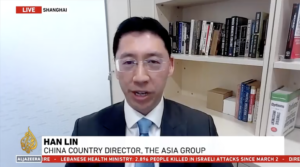
On why Xi warned that miscalculations over Taiwan could lead to conflict:
So in Chinese there’s an expression, you can be in the same bed with different dreams. And that seems to be U.S. and China’s situation. So certainly from the China side where I’m based in Shanghai here, the understanding is that China approached the summit more as a strategic stabilization exercise, maybe not quite the relationship reset that we might think of. So from Beijing’s perspective, structural competition with the U.S. is pretty permanent. And Xi Jinping’s goal is likely to reduce volatility rather than resolve a lot of core disagreements or the differences.
On how China prepared themselves to host President Donald Trump:
Well, certainly one aspect of the Chinese government is that every aspect of the summit was likely meticulously planned. And in particular, I want to highlight the fact that when Xi and Trump met with each other in Zhongnanhai, not every global leader has an opportunity to come to the inner sanctum of Zhongnanhai. And so that suggested that Xi was attempting more of a personal relationship beyond the institutional dynamics between U.S. and China.
But this is a shrewd move, because China understands if they don’t manage Trump well, it will have to deal with a more hawkish administration. So I suspect between the two, it would rather work with Trump and certainly Xi. It is in China’s interest in general to show that the relationship can remain manageable.
On what China needs right now:
So China is really playing a different game. They are very focused on being able to manage risks and to essentially buy time, especially around Taiwan, technology restrictions, military tensions. China wants clear guardrails to prevent crises from spiraling into direct confrontation. And the better they can manage global volatility, the more bandwidth they can focus on the domestic economy, which you’ve rightly highlighted has many challenges ahead. The property sector weakness, cautious consumers, slowing foreign investment. But the stabilizing ties with Washington, they’re meant to try to help reassure multinationals that China can remain commercially viable despite these geopolitical tensions.
On how China has presented itself as a more predictable place to invest, while normalizing its encirclement of Taiwan:
That is a very important question. It’s certainly it’s understood that every country thinks about their own self-interests first. But certainly at this particular summit, Xi wants China to appear as the steadier global actor in contrast to Washington’s more election-driven political swings.
But there’s a second point Xi is likely thinking beyond Washington. So the optics of the summit are also aimed at Europe, Southeast Asia, the Global South. China wants these countries to see Beijing as indispensable to global supply chains, climate cooperation and economic growth.
And despite the challenges, smaller or other nations may have with China, China would argue, well, what are the other options?
On whether there is any reason for the U.S. to back away quietly from the Asia Pacific region, given apparent threats to its allies there:
Certainly, that’s the key message that the US is continuing to determine as well, the extent of how they continue to focus on the security side of working with their allies. But definitely, what has come out of this summit is this that China has managed to create the perception of a confident peer power, rather than a country under pressure. And this is likely going to help fulfill a particular dynamic, which is to strengthen President Xi’s political hand and just to find a fourth term in 2027.
But we definitely know this. A key focus of China’s development future, both globally and through the 15th Five-Year plan domestically, is the focus of security, the focus of self-sufficiency. And that seems to be the primary driver continuing to go forward. But China has yet to manage how they’ll be able to, you know, mediate that with their other nations.
On whether China is willing to trade its influence over Tehran for concessions from the U.S., specifically on trade tariffs:
So the very fact that China purchases 90% of Iran’s oil exports makes clear that China has significant leverage over Iran. But it’s kind of like one chip. You can only use it once. And so it’s not very likely China will give up leverage on that for free.
So I do agree that in in support for providing support to the U.S. on Iran, China will likely ask for some form of quid pro quo, some form of transaction to be able to make it worthwhile. And that could include very much on the trade side, but it could also include other areas, such as the purchases of advanced chips as well. We don’t yet know how the formulation will come, but we do know that China is very well aware that despite the common interest the U.S. and China have in the opening of the Straits of Hormuz, China does have some leverage that they’re very likely going to want to use in some capacity.